English


Views: 0 Author: Site Editor Publish Time: 2026-10-13 Origin: Site
When sourcing CO2 cartridges from China, many buyers start the purchasing process by asking about price, MOQ, and delivery time.
However, for OEM and wholesale projects, an accurate quotation requires much more than basic purchasing information.
A professional CO2 cartridge RFQ (Request for Quotation) should clearly define the product requirements, including cartridge application, CO2 filling weight, dimensions, thread type, packaging requirements, destination market, and documentation expectations.
Without sufficient technical information, suppliers may misunderstand the application, recommend unsuitable products, or provide quotations that require multiple revisions.
For distributors, importers, and private-label brands, preparing a complete RFQ before contacting a manufacturer can improve communication efficiency, reduce product risks, and accelerate the sourcing process.
This guide explains the 12 key specifications buyers should confirm before requesting a CO2 cartridge OEM quotation from China.
A CO2 cartridge is not defined only by its gas capacity.
Two cartridges with the same CO2 filling weight may have different:
Dimensions
Thread specifications
Connection designs
Applications
Packaging requirements
Manufacturing requirements
For example, a 33g CO2 cartridge used for an inflatable life jacket is not necessarily interchangeable with another 33g cartridge designed for a different application.
Although both products contain the same nominal CO2 capacity, the connection design and equipment compatibility requirements may be different.
A complete OEM RFQ helps manufacturers evaluate:
Whether the requested cartridge matches existing models
Whether customization is technically feasible
What specifications need to be confirmed
What documents may be required
How production and packaging should be arranged
A detailed RFQ also helps buyers receive more accurate quotations and avoid unnecessary communication delays.
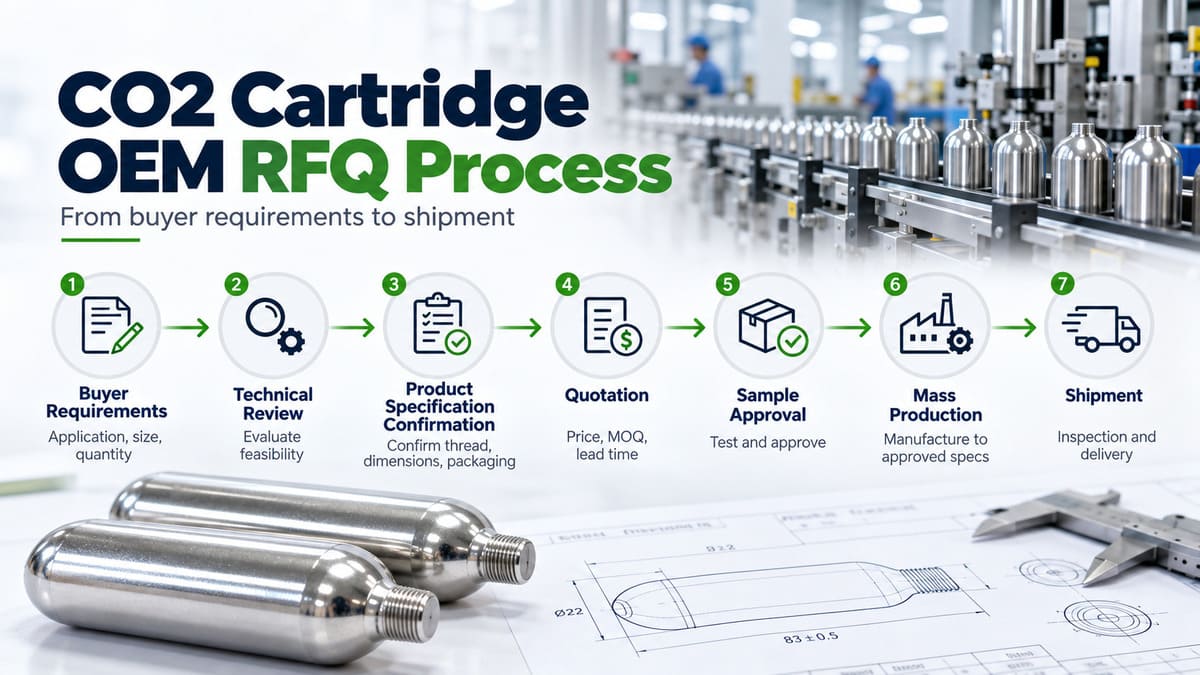
A typical CO2 cartridge OEM sourcing process includes the following stages:
The buyer provides product specifications, application details, quantity, packaging requirements, and target market information.
The manufacturer evaluates product feasibility and confirms technical requirements.
The supplier provides pricing, MOQ, lead time, and delivery terms.
The buyer reviews samples and confirms product compatibility.
Production begins according to the approved specifications.
Finished products are inspected and prepared for international delivery.
Providing complete information at the beginning helps prevent specification changes during later production stages.
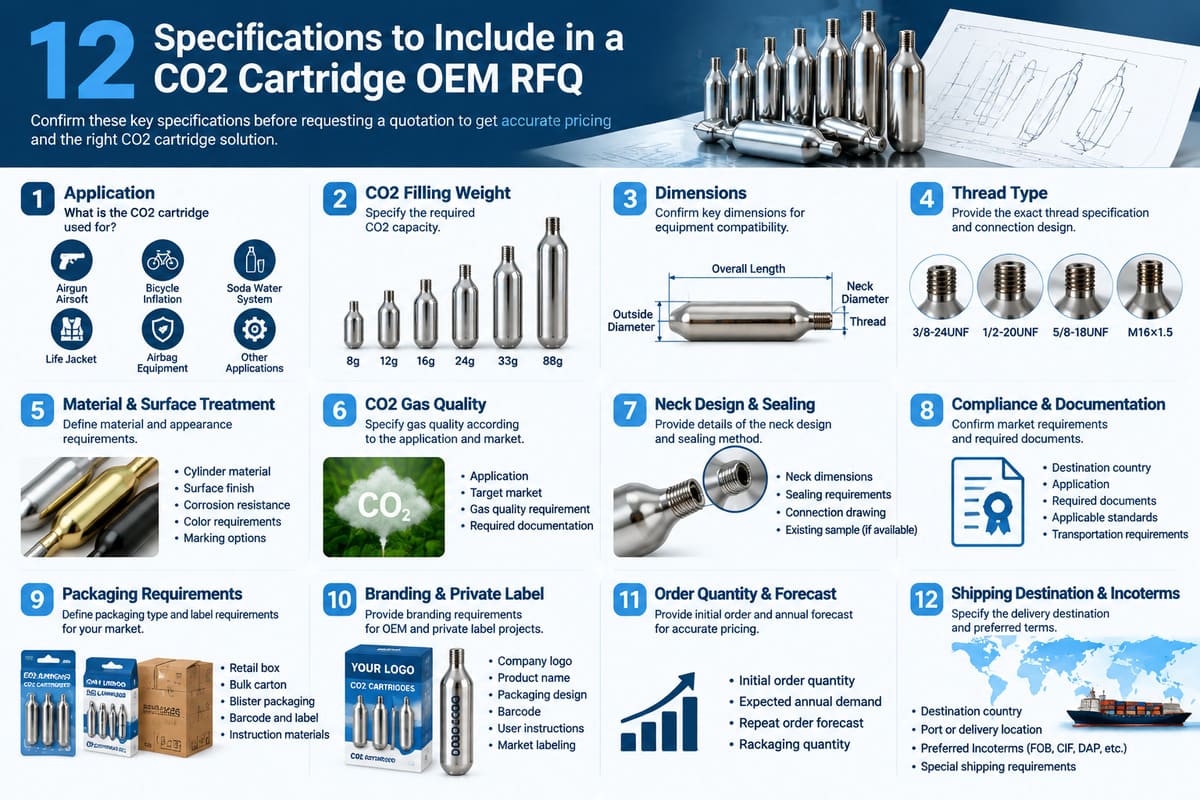
The first specification manufacturers need to understand is:
What is the CO2 cartridge used for?
The final application affects cartridge design, connection type, and product requirements.
Common CO2 cartridge applications include:
Airguns
Airsoft equipment
Bicycle tire inflation systems
Soda water machines
Inflatable life jackets
Protective airbag systems
Other specialized equipment
For example, Fairdale supplies different cartridge models for different applications, including:
When preparing an RFQ, buyers should explain the final application instead of only providing the cartridge size.
Manufacturers need to understand not only what product is required, but also how the product will be used.
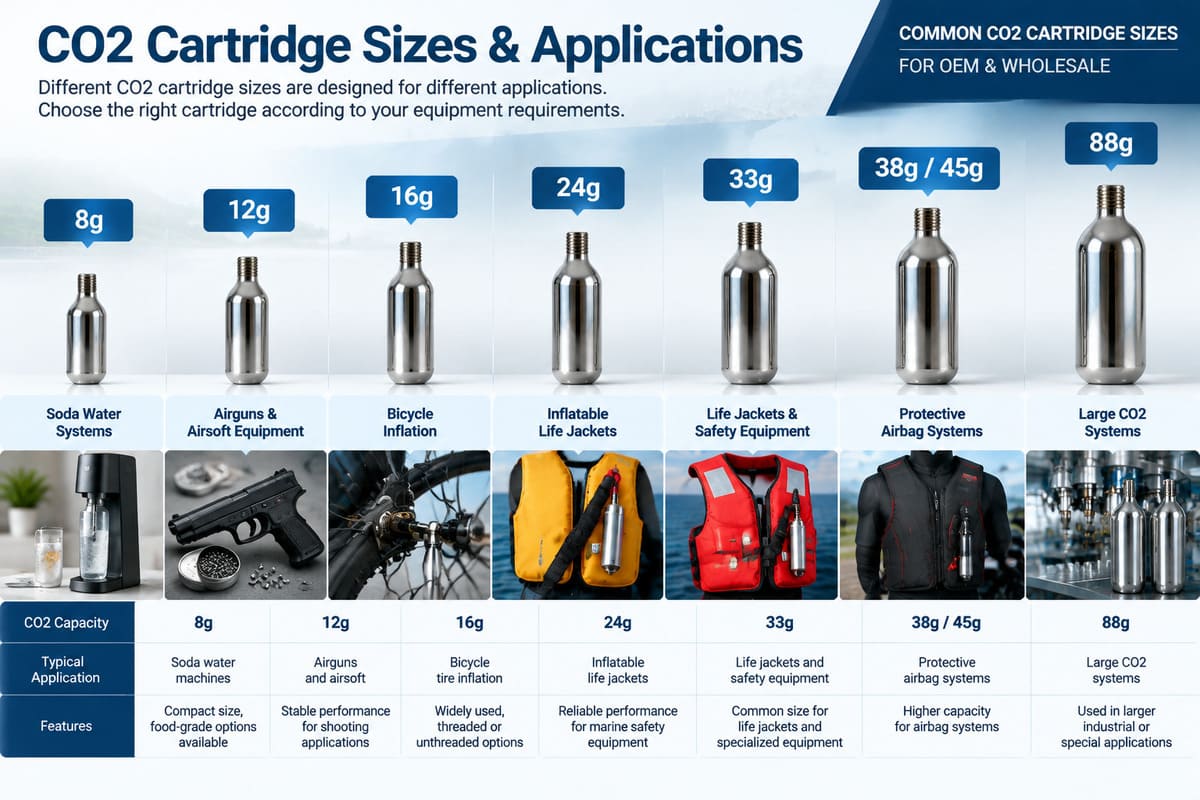
CO2 cartridges are commonly classified according to their filling weight.
Typical cartridge sizes include:
| CO2 Capacity | Common Application |
|---|---|
| 8g | Soda water systems |
| 12g | Airguns and airsoft equipment |
| 16g | Bicycle inflation |
| 24g | Inflatable life jackets |
| 33g | Life jackets and specialized equipment |
| 38g / 45g | Protective airbag systems |
| 88g | Larger CO2-powered equipment |
When requesting an OEM quotation, buyers should specify:
Required CO2 filling weight
Expected quantity
Intended application
Target market
Avoid descriptions such as:
"Standard CO2 cartridge"
or
"Small CO2 cylinder"
These descriptions are not sufficient for accurate product evaluation.
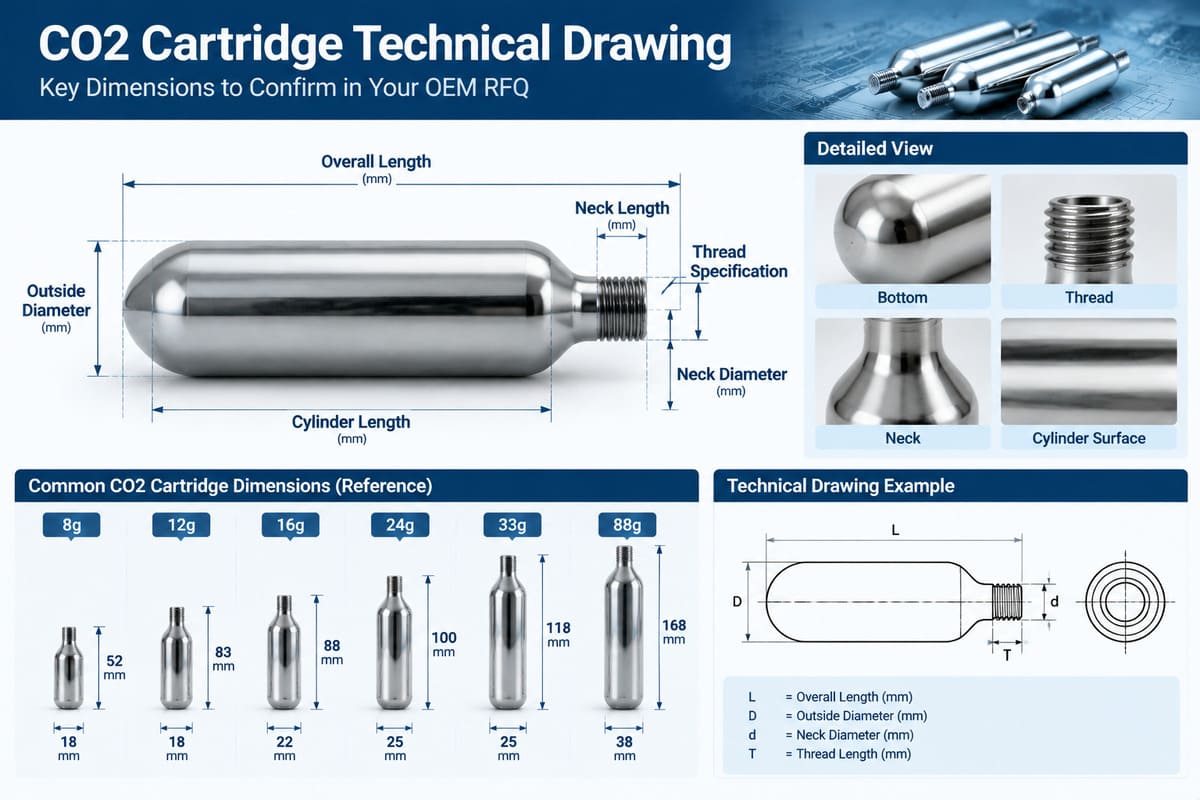
Physical dimensions are critical for product compatibility.
A complete RFQ should include:
Overall length
Outside diameter
Neck dimensions
Water capacity
Total weight requirements
A cartridge with the same CO2 capacity may still be unsuitable if the physical dimensions do not match the equipment.
For replacement projects, buyers should provide:
Existing cartridge samples
Technical drawings
Equipment specifications
Installation requirements
Providing accurate dimensional information allows manufacturers to determine whether an existing model can meet the requirement or whether customization is needed.
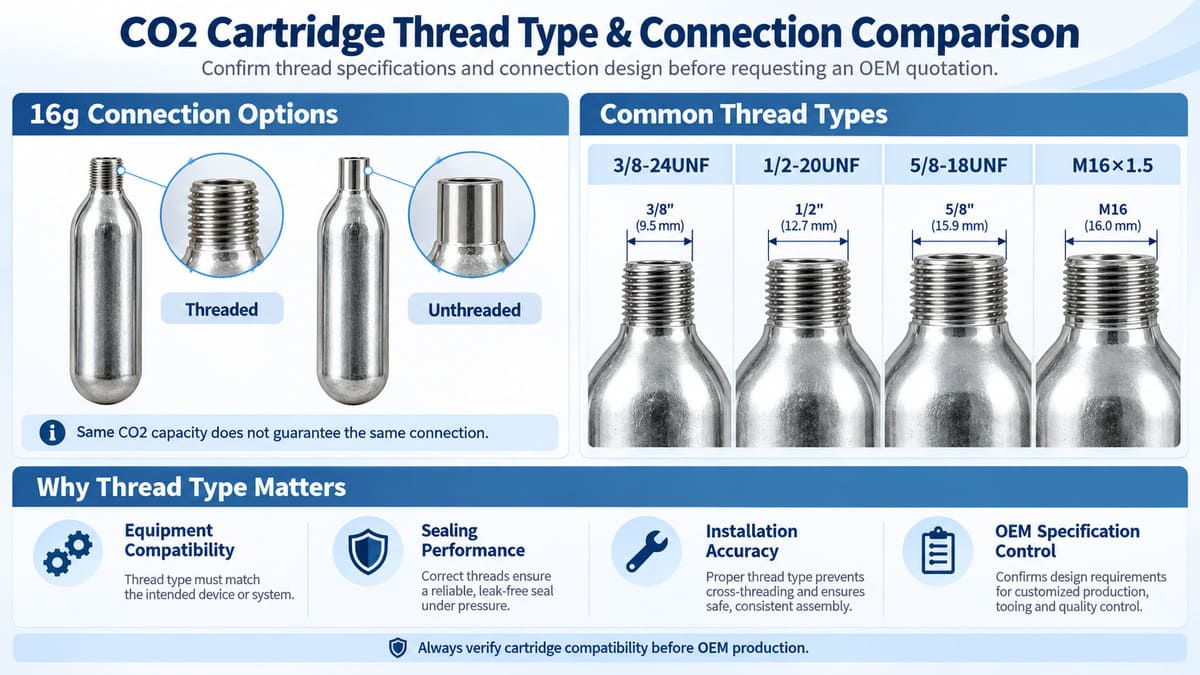
Thread specification is one of the most important technical details in CO2 cartridge sourcing.
Different applications may require different connection designs, including:
3/8-24UNF
1/2-20UNF
5/8-18UNF
M16×1.5
Buyers should never assume that cartridges with the same gas capacity use the same connection.
For example:
A 16g CO2 cartridge may be available in both threaded and unthreaded versions.
Similarly, different 33g CO2 cartridge applications may require different thread configurations.
When preparing an OEM RFQ, buyers should provide:
Thread standard
Thread size
Connection drawing
Equipment compatibility information
For buyers sourcing bicycle inflation products, Fairdale provides 16g CO2 cartridges for tire inflation applications.
For marine safety applications, buyers can review Fairdale's 33g CO2 cartridge solutions.
OEM buyers should define material and appearance requirements before production.
Important specifications may include:
Cartridge material
Surface finish
Corrosion resistance requirements
Product markings
Appearance standards
For private-label projects, buyers may also request:
Logo marking
Custom packaging
Product identification
However, customization requirements should always be reviewed with the manufacturer to confirm technical feasibility.
Different applications may require different CO2 quality considerations.
When preparing an RFQ, buyers should specify:
Intended application
Target market
Required documentation
For example:
A beverage-related application may require different quality considerations compared with sporting goods applications.
Instead of writing:
"High purity CO2 required"
a professional RFQ should explain:
Where the product will be used
Which market it will enter
What documentation is required
This allows manufacturers to evaluate the correct production requirements.
The cartridge neck design affects:
Equipment connection
Gas release method
Sealing performance
Compatibility
For OEM replacement projects, buyers should provide:
Existing cartridge samples
Technical drawings
Connection specifications
A cartridge that looks similar does not always guarantee compatibility.
Technical confirmation before production can prevent:
Installation problems
Product returns
Customer complaints
Compliance requirements depend on:
Destination country
Product application
Transportation method
Customer requirements
Before requesting a quotation, buyers should clarify:
Target market
Intended application
Required documents
For example, a cartridge supplied for marine safety equipment may have different documentation requirements compared with a cartridge used for recreational equipment.
Manufacturers need this information early to evaluate the project correctly.
Packaging is an important part of OEM projects.
Buyers should specify:
Retail box requirements
Bulk carton packaging
Barcode requirements
Label design
Instruction materials
Packaging affects:
Production planning
Cost calculation
Lead time
For distributors building their own product brands, packaging should be discussed together with product specifications.
Fairdale supports OEM projects including product packaging and private-label requirements through its CO2 cartridge OEM services.
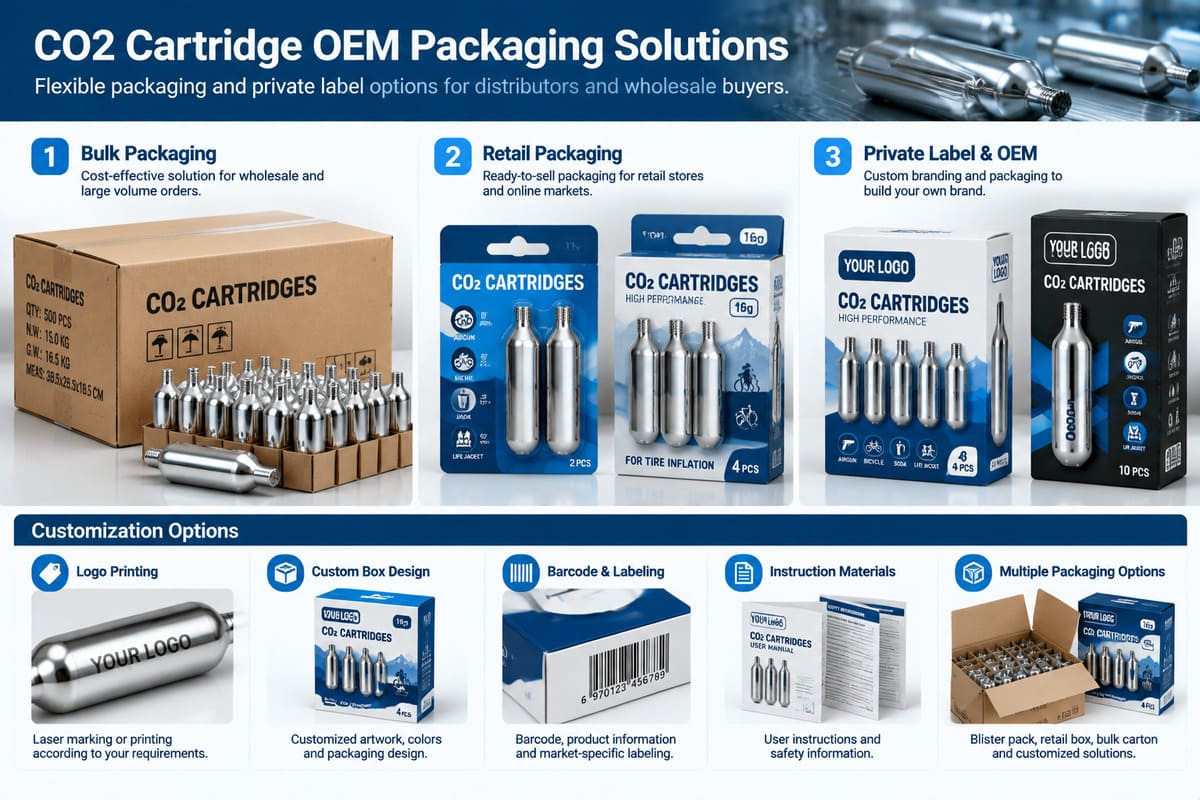
Many distributors choose OEM CO2 cartridges because they want to develop their own branded products.
Private-label requirements may include:
Company logo
Product name
Retail packaging
Barcode
User instructions
Market-specific labeling
When requesting OEM pricing, buyers should prepare:
Logo files
Packaging artwork
Target market information
Expected order quantity
Clear branding requirements help manufacturers evaluate production requirements and provide more accurate quotations.
Quantity information is essential for accurate pricing.
Buyers should provide:
Initial order quantity
Expected annual demand
Repeat order forecast
Packaging quantity
Order volume affects:
Unit price
Production scheduling
Packaging cost
Supply planning
For long-term cooperation, manufacturers often prefer understanding future purchasing plans rather than only one single order.
The final specification manufacturers need is delivery information.
Buyers should provide:
Destination country
Port or delivery location
Preferred Incoterms
Common examples include:
FOB
CIF
DAP
Shipping information affects:
Freight calculation
Export documentation
Delivery planning
A quotation without destination information may not represent the actual final purchasing cost.
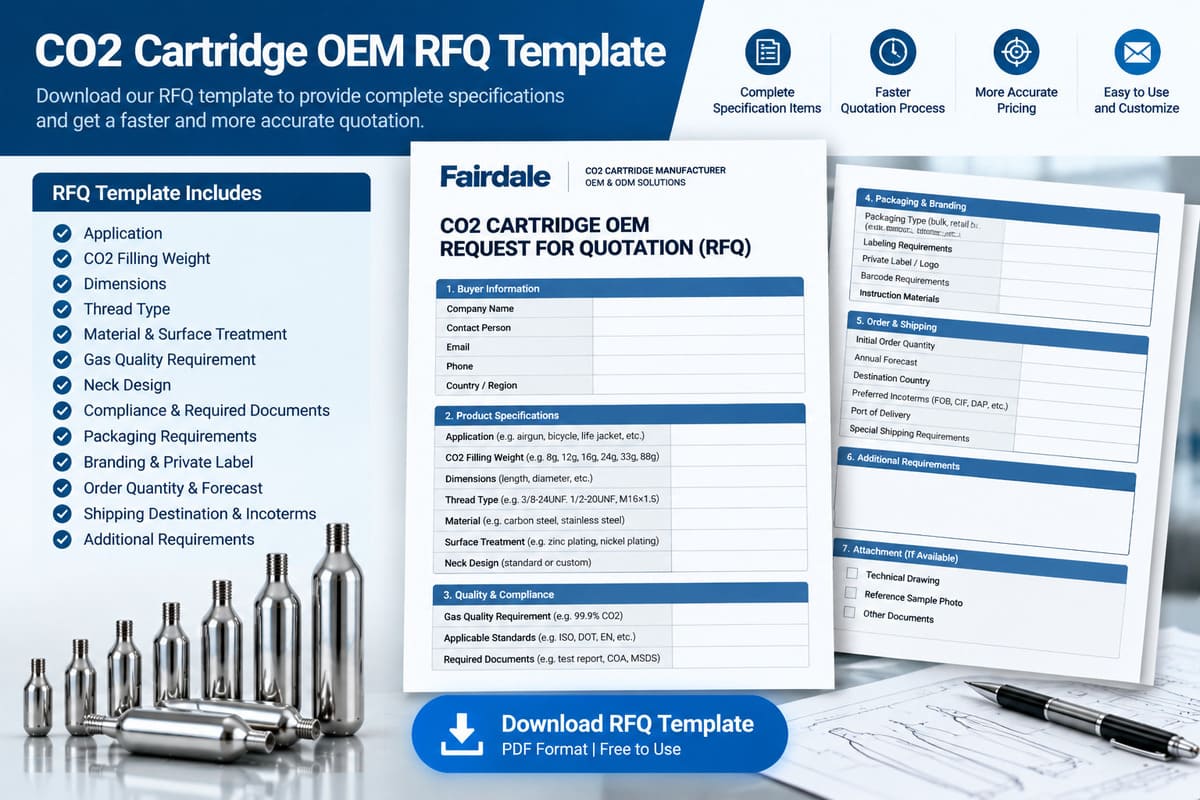
Before contacting a manufacturer, buyers can prepare the following information.
Product Type:
CO2 Cartridge
Application:
CO2 Capacity:
Thread Type:
Dimensions:
Existing Sample Available:
Yes / No
Order Quantity:
Packaging Requirements:
Destination Market:
Required Documents:
Preferred Incoterm:
| Mistake | Possible Result |
|---|---|
| Only providing CO2 capacity | Incorrect product recommendation |
| Ignoring application | Compatibility problems |
| Not specifying thread type | Incorrect connection |
| Requesting price too early | Inaccurate quotation |
| Ignoring packaging requirements | OEM delays |
| Not providing destination | Incorrect shipping calculation |
A complete RFQ saves time for both buyers and manufacturers.
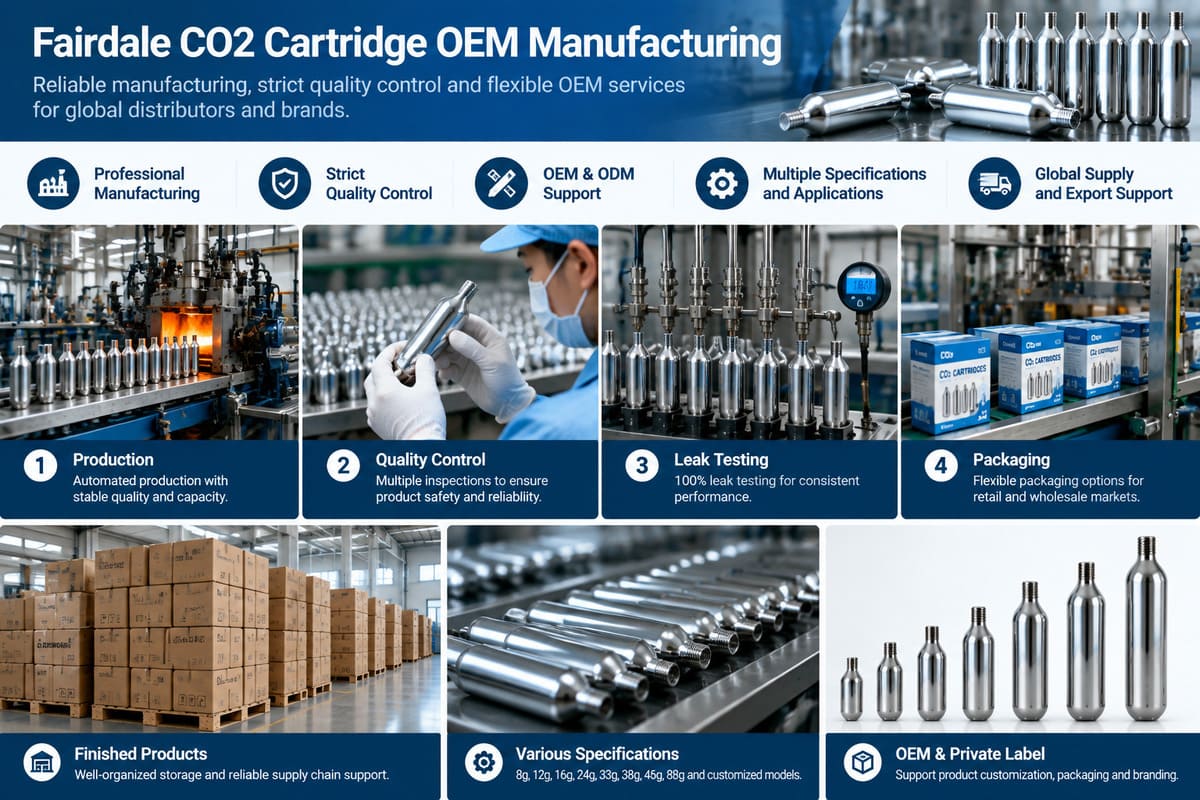
Selecting the right manufacturing partner is an important step for distributors building a reliable CO2 cartridge supply chain.
Fairdale specializes in miniature CO2 cartridges for different commercial applications, including:
Sporting equipment
Bicycle inflation systems
Beverage systems
Inflatable life jacket applications
Protective airbag equipment
Fairdale supports OEM buyers with:
Product specification discussions
Manufacturing evaluation
Packaging requirements
Private-label projects
Export support
Learn more about Fairdale:
A complete RFQ should include cartridge application, CO2 capacity, dimensions, thread type, quantity, packaging requirements, destination market, and required documentation.
Yes. OEM customization may include packaging, branding, labeling, and selected product requirements. Custom specifications should be evaluated according to technical feasibility.
Thread specifications depend on the cartridge model and application. Common configurations include 3/8-24UNF, 1/2-20UNF, 5/8-18UNF, and M16×1.5.
Buyers should evaluate manufacturing experience, product range, technical capability, quality control processes, communication efficiency, and export experience.
MOQ depends on cartridge model, customization requirements, packaging, and production conditions. Buyers should confirm MOQ according to their specific project.
Yes. Many distributors work with manufacturers to develop branded products with customized packaging and labeling.
A successful OEM project starts with accurate product information.
Before requesting a quotation, prepare:
Cartridge application
CO2 capacity
Thread specification
Quantity
Packaging requirements
Destination market
Fairdale can review your requirements and recommend suitable CO2 cartridge solutions.
Contact Fairdale:
https://www.fairdaleco.com/contactus.html


