English


Views: 0 Author: Site Editor Publish Time: 2026-10-19 Origin: Site

When sourcing CO2 cartridges, buyers often encounter terms such as food-grade CO2, industrial-grade CO2, high-purity CO2, and beverage-grade CO2. Although these terms may appear similar, they do not necessarily describe products with the same specifications or intended uses.
For distributors, importers, beverage equipment manufacturers, and OEM brands, choosing the right CO2 cartridge involves more than comparing purity percentages or unit prices. Buyers also need to consider gas specifications, impurity controls, cartridge cleanliness, filling processes, documentation, equipment compatibility, and destination-market requirements.
Carbon dioxide is used in both food-related and industrial applications. However, the suitability of a particular CO2 supply depends on its specification and intended use. For example, the U.S. regulation 21 CFR 184.1240 for carbon dioxide states that the ingredient must have a purity suitable for its intended use and be used in accordance with current good manufacturing practice.
For buyers, the key question is not simply whether a cartridge contains CO2. It is whether the gas, cartridge, and associated quality controls are appropriate for the intended application.
This guide explains the differences between food-grade and industrial-grade CO2, how to evaluate product quality, which documents to request, and what to confirm before choosing a CO2 cartridge supplier.
Food-grade and industrial-grade CO2 are both carbon dioxide, but they may be supplied under different specifications according to their intended applications.
Food-related applications require the gas to meet the requirements applicable to the intended use. Industrial applications are generally evaluated against the technical requirements of the process or equipment.
The distinction is therefore not simply a comparison between two purity percentages. Buyers need to understand the complete specification behind each product.
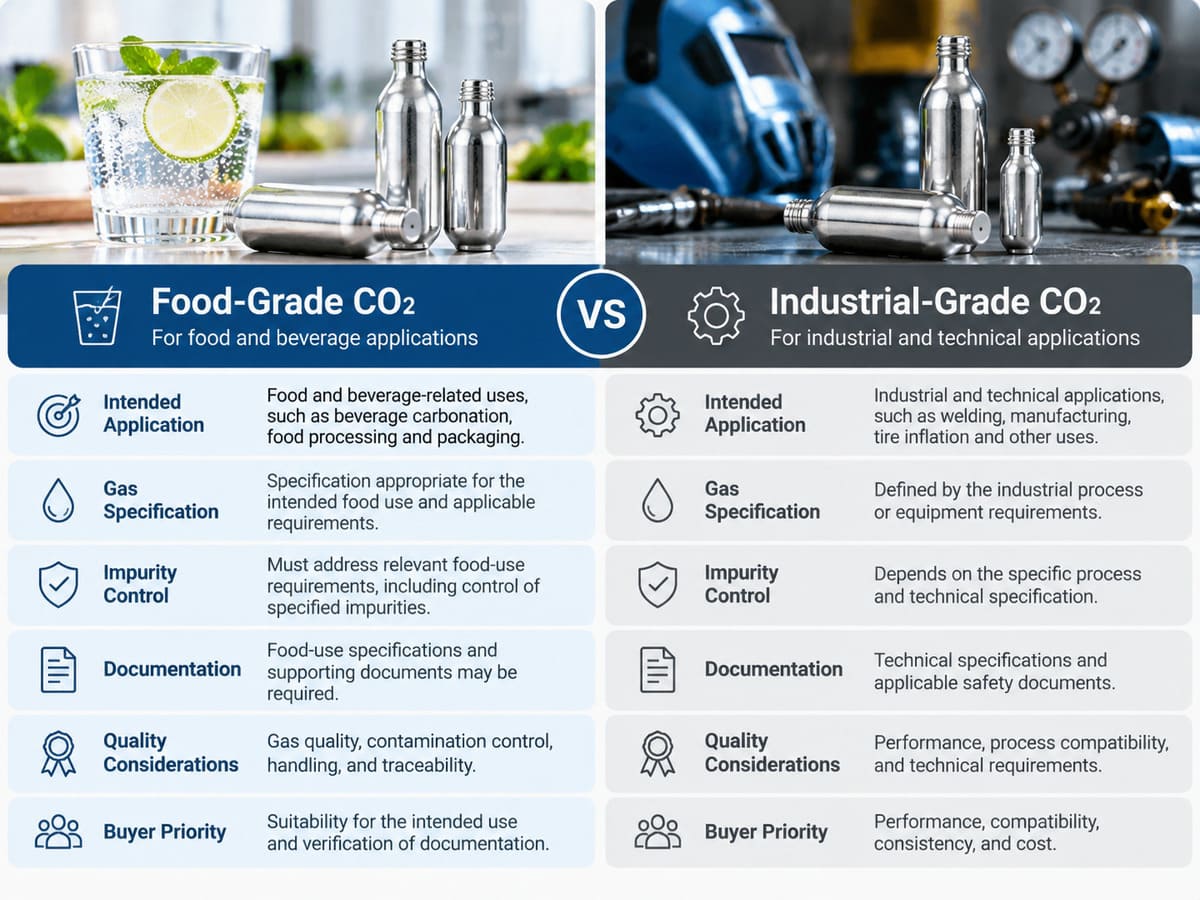
| Factor | Food-Grade CO2 | Industrial-Grade CO2 |
|---|---|---|
| Intended application | Food and beverage-related uses | Industrial and technical processes |
| Gas specification | Appropriate for the intended food use and applicable requirements | Defined by the industrial application |
| Impurity control | Must address relevant food-use requirements | Depends on the process and technical specification |
| Documentation | Food-use specifications and supporting documents may be required | Technical specifications and applicable safety documents |
| Quality considerations | Gas quality, contamination control, handling, and traceability | Performance, process compatibility, and technical requirements |
| Buyer priority | Suitability for the intended use and verification of documentation | Performance, compatibility, consistency, and cost |
The Codex General Standard for Food Additives (GSFA) identifies carbon dioxide as food additive INS 290 and provides provisions for its use according to food categories and applicable conditions.
In the United States, 21 CFR 184.1240 addresses carbon dioxide used as a food ingredient. In the European Union, the EU food additive regulation provides the regulatory framework for food additives, including carbon dioxide identified as E 290.
These references demonstrate why food-use suitability should be evaluated against the applicable requirements rather than a single universal purity threshold.
The main difference is the combination of intended use, gas specifications, impurity controls, production practices, and supporting documentation.
For example, CO2 used in a compatible bicycle tire-inflation system has different purchasing considerations from CO2 intended for beverage carbonation. The cartridges may also have different dimensions, connection types, and equipment compatibility requirements.
Buyers should therefore identify the application before requesting a quotation.
Instead of asking a supplier for high-purity CO2 cartridges without further details, a more useful request would specify:
Intended application
Required CO2 specification
Cartridge capacity and dimensions
Connection type
Target market
Documentation requirements
Estimated order quantity
This information helps the manufacturer evaluate the product more accurately and reduces the risk of receiving a quotation for an unsuitable configuration.
For distributors comparing products for different applications, Fairdale's CO2 cartridge product range includes cartridge options for beverage equipment, airguns, tire inflation, life jackets, and other applications.
Food-grade CO2 generally refers to carbon dioxide supplied under specifications appropriate for food or beverage applications. However, buyers should not assume that the term has one identical specification in every country or for every application.
The exact requirements depend on the intended use, relevant regulations, and the specification agreed between the buyer and supplier.
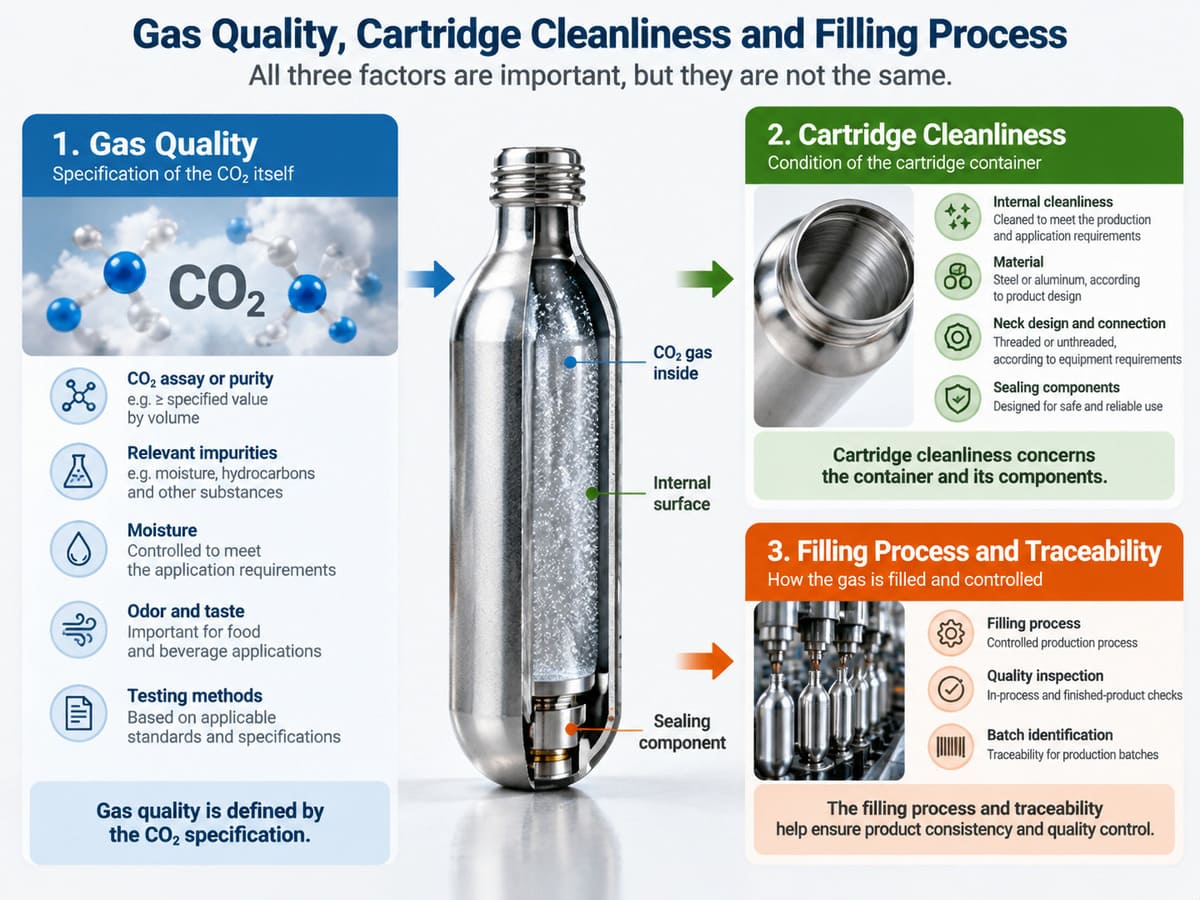
One important distinction is the difference between gas quality and cartridge quality.
Gas quality concerns the CO2 itself, including its assay or purity, relevant impurities, and other parameters specified for the intended application.
Cartridge quality concerns the container and the processes used to manufacture, clean, handle, and fill it. Depending on the design, relevant considerations may include internal cleanliness, neck configuration, sealing components, and contamination controls.
These are related but separate issues.
A cartridge made from steel or aluminum is not automatically suitable for food or beverage use simply because of its material. Likewise, a high-purity gas specification alone does not establish that every aspect of the cartridge and filling process meets the requirements of a particular food application.
Buyers should evaluate the gas specification and the cartridge manufacturing process together.
A purity figure such as 99.9% or 99.99% can be useful, but it does not describe every possible impurity or quality parameter.
The JECFA specification for carbon dioxide provides a technical reference for evaluating carbon dioxide as a food additive. The specification framework includes more than a single assay value.
For this reason, buyers should ask suppliers for a written specification rather than relying only on a purity percentage printed in a catalogue or quotation.
Depending on the application, the specification may address:
CO2 assay or purity
Relevant impurities
Moisture
Oil or hydrocarbon contamination, where relevant
Odor-related requirements
Testing methods
Batch identification and traceability
The parameters and acceptance limits should be defined according to the applicable requirements rather than assumed to be identical for every project.
Food-use requirements can differ between destination markets. A product intended for sale in the United States may need to be evaluated under a different regulatory framework from a product intended for the European Union or another market.
For U.S.-market projects, buyers can consult 21 CFR 184.1240 for carbon dioxide. For international food-additive references, the Codex GSFA database and the JECFA food additive specification database provide useful starting points.
These references do not replace a market-specific compliance assessment. Buyers should confirm which requirements apply to their product, application, and destination.
Buyers should not automatically assume that industrial-grade CO2 is suitable for beverages simply because the gas is chemically carbon dioxide.
The correct decision depends on the actual gas specification, the production and handling controls, the intended use, and the requirements of the destination market.
If CO2 will be used for soda water, sparkling water, beverage carbonation, or another food-related application, the buyer should communicate that requirement clearly before placing an order.
Before purchasing CO2 cartridges for beverage applications, buyers should confirm the following points with the supplier.
1. Intended use
Explain whether the CO2 will be used for direct beverage carbonation or another food-related purpose. This helps the supplier identify the relevant specification requirements.
2. Gas specification
Request a written specification covering the CO2 assay and other relevant parameters. Confirm that the specification is suitable for the intended application.
3. Quality controls
Ask how the gas and cartridges are handled, tested, and controlled during production. The details required will depend on the product and applicable requirements.
4. Supporting documentation
Confirm which test reports, specifications, batch records, or other documents are available for the project.
5. Destination market
Identify the country where the product will be sold or used. The buyer should verify the applicable food-use and product requirements for that market.
The U.S. regulation 21 CFR 184.1240, for example, states that carbon dioxide used as a food ingredient must have a purity suitable for its intended use and be used according to current good manufacturing practice.
The practical lesson is that an industrial-grade label does not establish suitability for beverage use, and a high-purity claim does not replace the necessary verification.
The document package depends on the project, but buyers may request:
Written CO2 specification
Applicable test reports or Certificate of Analysis
Relevant impurity specifications
Product and cartridge specifications
Batch identification or traceability information
Food-use documentation, where applicable
Safety and shipping documents, where required
Not every project will require the same documents. The buyer should define the requirements early and obtain confirmation from the supplier before production or shipment.
For beverage equipment distributors, Fairdale maintains a dedicated beverage CO2 cartridges product category. Buyers evaluating a particular cartridge should still confirm the gas specification and supporting documentation required for their own application.
A reliable CO2 cartridge evaluation should cover the gas, the cartridge, the filling process, and the supporting documents.
For distributors and OEM buyers, the following checks provide a practical starting point.
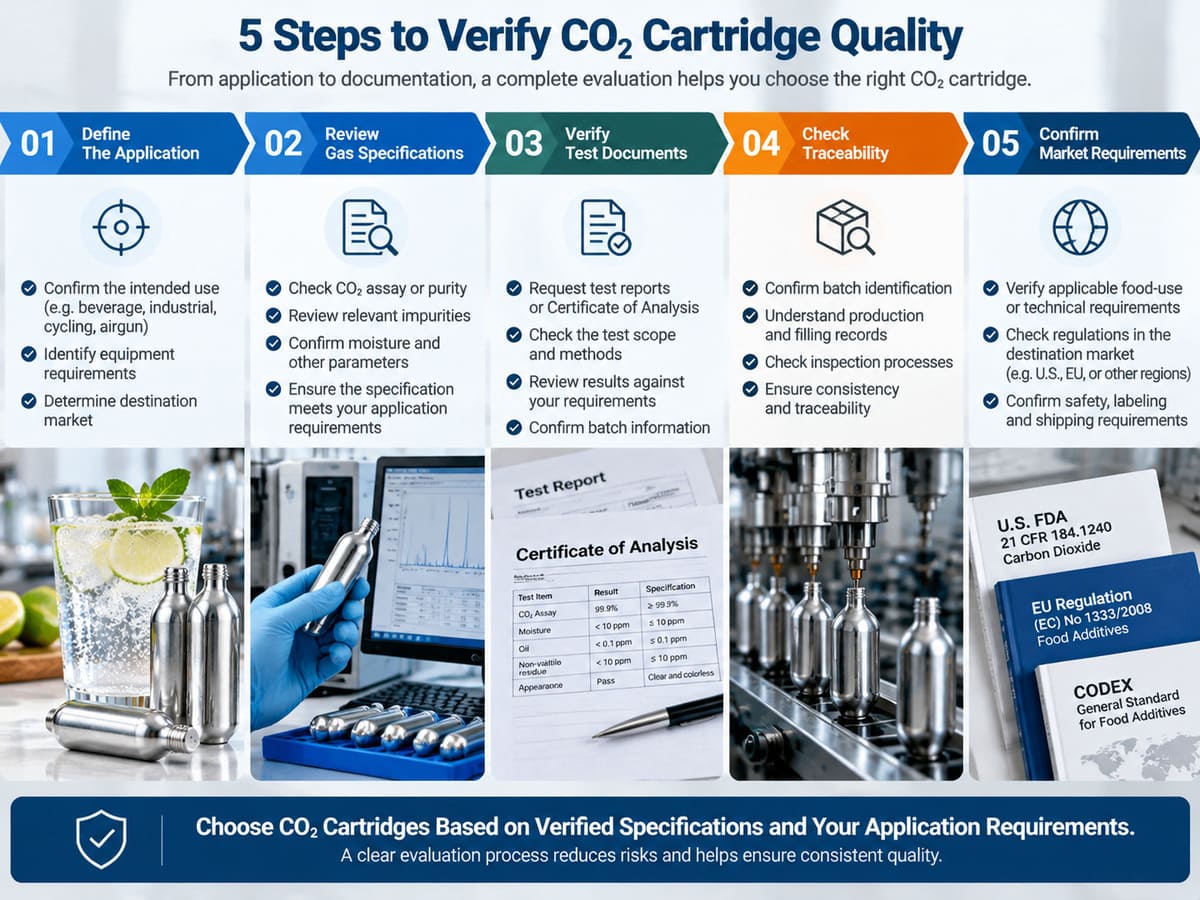
Start by requesting the supplier's written gas specification.
Depending on the application, the specification may include CO2 assay, relevant impurities, moisture, and other parameters required for the intended use.
Do not treat a single purity percentage as a complete quality assessment. Instead, compare the documented specification against the requirements of the project.
The JECFA specification for carbon dioxide is one reference buyers can consult when researching food-additive specifications. The applicable requirements should still be confirmed for the target market and intended use.
The cartridge must also match the equipment and project requirements.
Confirm:
Cartridge material
Outside diameter and overall length
Water capacity, where applicable
Neck design
Thread or connection type
Sealing components, where applicable
Internal cleanliness requirements
Product markings and packaging
A cartridge with the correct CO2 capacity may still be unsuitable if its dimensions or connection do not match the equipment.
For example, Fairdale's 8g CO2 cartridge for soda water machines is listed as an unthreaded cartridge with a nominal CO2 fill of 8g, an outside diameter of 17.8–17.9 mm, and an approximate length of 65 mm.
These are product configuration details, not proof of a particular food-grade certification. If a project requires a defined food-use gas specification or supporting documentation, buyers should state those requirements explicitly and obtain written confirmation before ordering.
The filling process is another important part of supplier evaluation.
Buyers may want to understand how the manufacturer controls filling operations, product consistency, finished-product inspection, and batch identification.
The exact controls depend on the cartridge design and the requirements of the application. For projects with specific quality requirements, the buyer should identify those requirements in the RFQ and agree on the applicable inspection and documentation arrangements before production.
Fairdale's CO2 cartridge manufacturing and OEM services describe its manufacturing capabilities and quality-control processes for commercial cartridge projects.
When reviewing any supplier, distinguish between general manufacturing capabilities and evidence that a specific product configuration meets a particular food-use requirement.
Before approving a supplier, confirm which documents will be provided and what each document actually demonstrates.
For example, a product specification describes agreed technical characteristics. A test report provides results for the parameters tested. A Certificate of Analysis, when provided, should be reviewed for its stated product, batch, test scope, and acceptance criteria.
A document should not be assumed to prove more than it actually covers.
Buyers should also verify whether additional regulatory, transportation, or customer-specific requirements apply to the destination market.
This approach creates a clearer basis for supplier comparison and helps prevent misunderstandings after production has started.
Choosing a supplier involves more than comparing unit prices. For distributors, importers, and private-label brands, the supplier should be able to evaluate the intended application, technical specification, production requirements, documentation needs, and commercial order.
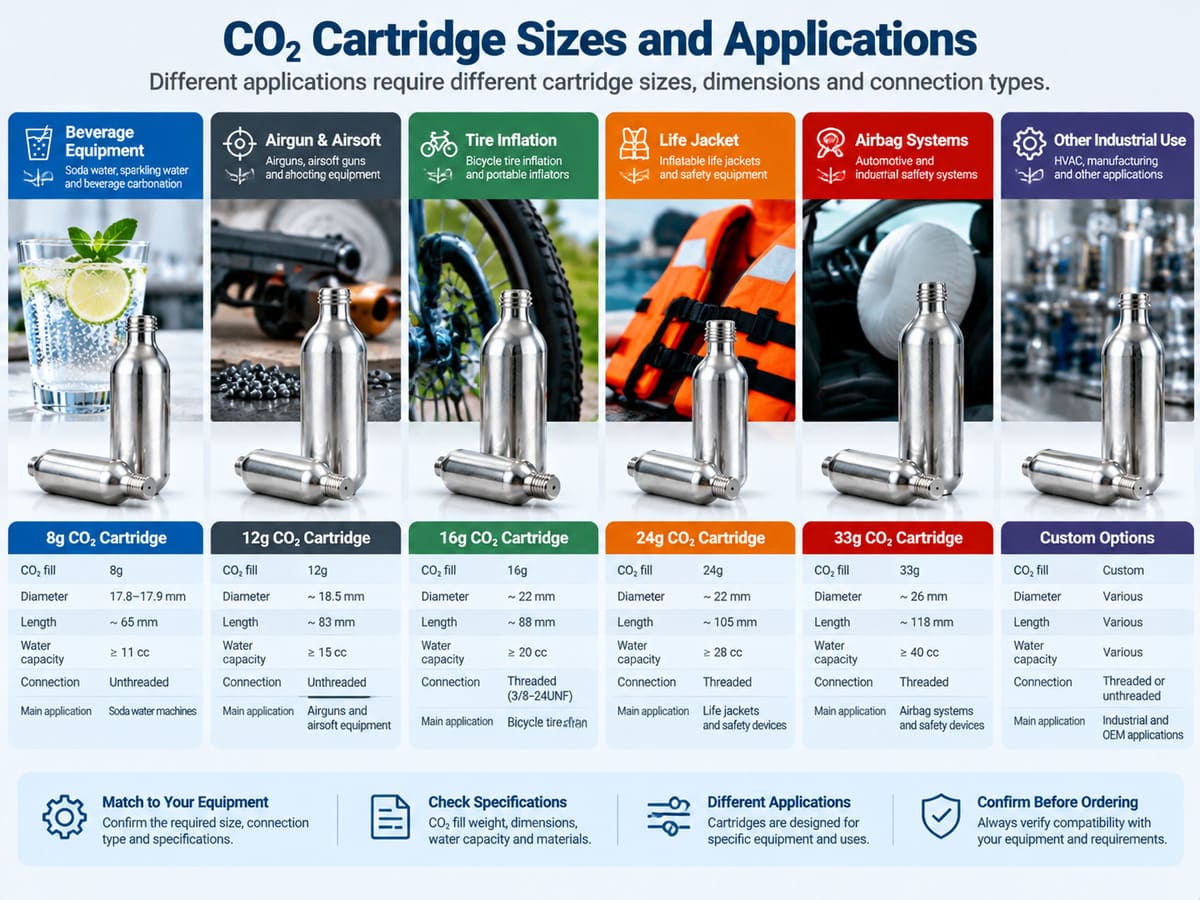
Start with the equipment or application rather than selecting a cartridge based only on filling weight.
For beverage equipment, confirm the required cartridge capacity, dimensions, connection type, and applicable gas specification.
For tire inflation, airguns, life jackets, or other industrial and technical applications, the product must match the relevant equipment and use requirements.
Fairdale's CO2 cartridge product range includes multiple cartridge configurations for different applications. Buyers can review the relevant product page and confirm the specification required for their equipment.
For compatible soda-water machines, the 8g CO2 cartridge product page provides the standard model's published dimensions and configuration. For bicycle inflation equipment, the 16g CO2 cartridge for tire inflation provides information about a different cartridge format and connection.
These examples illustrate why cartridge capacity, dimensions, and connection should be considered together.
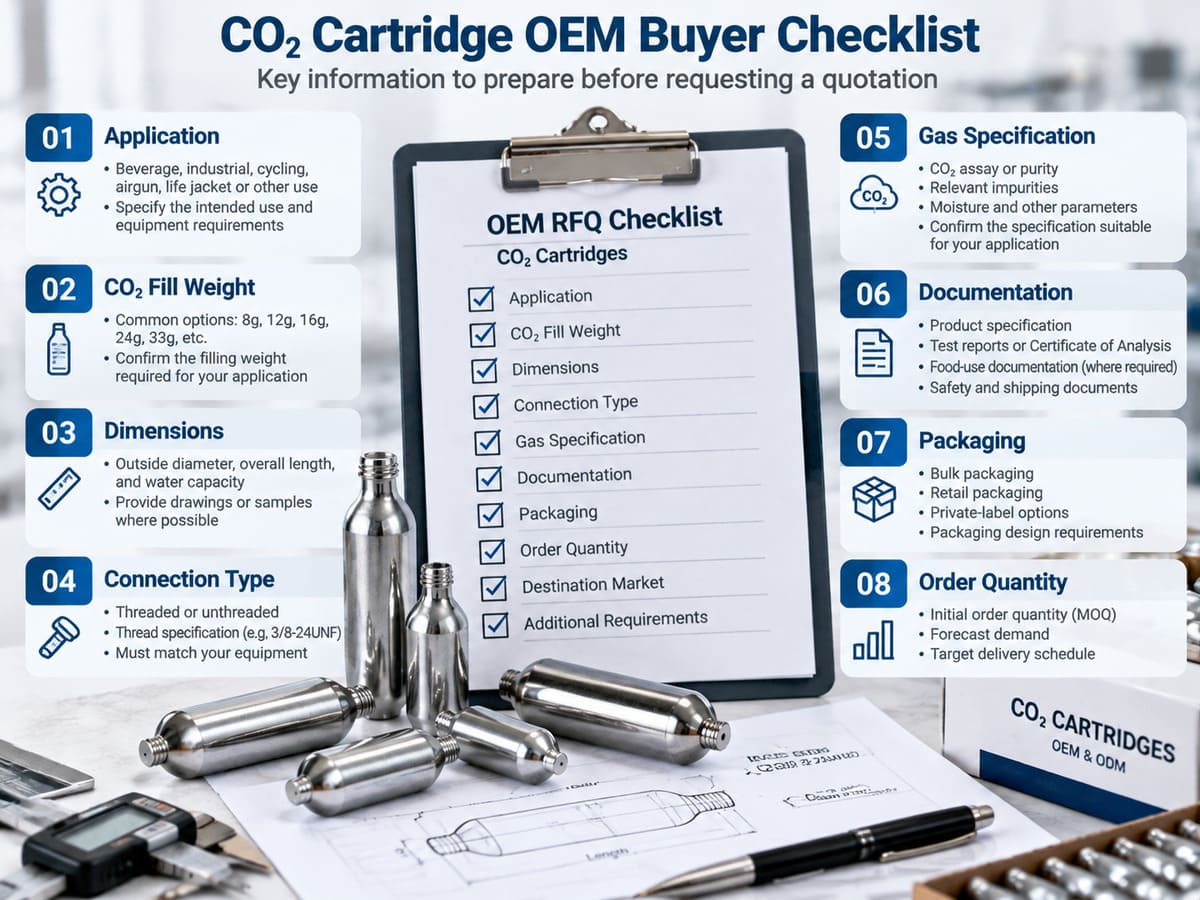
For an OEM or private-label project, prepare the following information before requesting a quotation.
| Specification | Information to Provide |
|---|---|
| Application | Beverage, industrial, cycling, airgun, or other use |
| CO2 capacity | Required filling weight |
| Gas specification | Required grade and applicable parameters |
| Cartridge dimensions | Diameter, length, and neck configuration |
| Connection | Threaded or unthreaded, including thread specification where relevant |
| Equipment compatibility | Equipment model, drawing, or sample |
| Quality requirements | Cleaning, inspection, and traceability expectations |
| Documentation | Required specifications, test reports, and applicable compliance documents |
| Packaging | Bulk, retail, or private-label packaging |
| Destination market | Country or region where the product will be sold |
| Order quantity | Initial order and expected demand |
| Shipping requirements | Destination, delivery terms, and required shipping documents |
For a more detailed purchasing template, use the CO2 Cartridge OEM RFQ Checklist. It explains the product, technical, packaging, quantity, and shipping details buyers should prepare before requesting a quotation.
A complete RFQ helps the supplier evaluate the project and gives both parties a clearer reference for the quotation, sample approval, and production stages.
Before placing a commercial order, consider asking:
What is the complete gas specification for the requested application?
Which quality parameters are tested, and which test reports are available?
How are cartridge cleaning and filling requirements controlled?
What batch identification or traceability information can be provided?
Which documents are available for the target market?
Does the cartridge match the required dimensions and connection?
Can the supplier support the required packaging and private-label specifications?
What inspection and approval steps should be completed before mass production?
These questions are particularly important when the product will be used in a beverage application. Buyers should specify the intended food use and required documentation rather than assuming that all cartridges in a particular product category have identical gas specifications or regulatory status.
Fairdale provides CO2 cartridge OEM and manufacturing services for commercial projects. For any application with specific food-use requirements, those requirements should be stated in the RFQ and confirmed with the supplier before production.
For additional sourcing considerations, the guide to importing CO2 cartridges from China covers the broader purchasing and import process.
Not necessarily in every case. Purity percentages alone do not establish whether a particular CO2 supply is suitable for a food application. Buyers should review the complete specification, relevant impurities, production controls, and applicable requirements for the intended use.
No. A purity percentage is only one part of the specification. Buyers should request the complete gas specification and confirm whether it meets the requirements of the intended application and destination market.
Buyers should not assume that industrial-grade CO2 is suitable for soda water. The actual gas specification and supporting documentation must be evaluated against the relevant food-use requirements. Confirm the intended use with the supplier before ordering.
No. The terms address different aspects of the product. Food-grade CO2 concerns the gas specification and suitability for the intended use. Cartridge quality concerns the container, cleanliness, materials, filling process, and other relevant product controls. Both should be evaluated for a beverage application.
Depending on the application and destination market, buyers may request a written CO2 specification, applicable test reports or Certificate of Analysis, product specifications, batch or traceability information, food-use documentation where applicable, and relevant safety or shipping documents. The required document package should be agreed before production.
Start with the intended application. Then confirm the gas specification, cartridge capacity, dimensions, connection type, equipment compatibility, documentation, and destination-market requirements. This is more reliable than selecting a cartridge based only on price or filling weight.
The difference between food-grade and industrial-grade CO2 cartridges is not simply a matter of comparing purity percentages.
For professional buyers, the most reliable approach is to evaluate the complete product specification, including the intended application, gas quality, relevant impurities, cartridge construction, filling controls, documentation, equipment compatibility, and destination-market requirements.
For beverage applications, buyers should be particularly careful not to treat a product label or a high-purity claim as sufficient proof of suitability. The gas specification and cartridge requirements should be confirmed for the actual project.
For industrial applications, the priority is to select a cartridge that meets the equipment's technical requirements and the intended operating conditions.
For distributors and OEM brands, a clear specification also makes it easier to compare suppliers, reduce compatibility problems, and agree on quality expectations before mass production.
Fairdale supplies CO2 cartridges for multiple applications and provides CO2 cartridge OEM and manufacturing services for commercial projects.
If you are sourcing CO2 cartridges for beverage equipment, industrial applications, or a private-label product line, prepare your application details, required cartridge dimensions, gas specification, documentation needs, packaging requirements, target market, and expected quantity before requesting a quotation.
To discuss a project, contact Fairdale about your CO2 cartridge requirements.


