English


Views: 0 Author: Site Editor Publish Time: 2026-10-13 Origin: Site
Shipping CO2 cartridges internationally requires more planning than arranging transportation for ordinary consumer products. Although carbon dioxide is widely used in sporting goods, bicycle inflation systems, beverage equipment, and inflatable safety devices, CO2 cartridges are pressurized gas containers that may be subject to dangerous goods transportation regulations.
For distributors importing CO2 cartridges from China, choosing the correct freight method is only one part of the process. Buyers must also understand the applicable UN classification, shipping documents, packaging requirements, carrier restrictions, and destination-country procedures.
One particularly important question is whether a shipment should be classified under UN2037 or UN1013. These entries are not interchangeable, and the correct classification cannot be determined from the CO2 filling weight alone.
A 12g non-refillable cartridge, a threaded 33g cartridge, and a larger refillable CO2 cylinder may have different transport considerations depending on their construction and applicable regulations.
This guide explains how to ship CO2 cartridges from China, covering dangerous goods classification, IMDG and IATA requirements, shipping documents, export packaging, sea and air freight, transportation costs, and practical checks before dispatch.
It is written for international distributors, importers, wholesalers, and OEM buyers planning commercial CO2 cartridge shipments.
To ship CO2 cartridges internationally, distributors should first confirm the exact product specifications and applicable dangerous goods classification. Depending on the cartridge design and regulatory conditions, relevant entries may include UN2037 for certain small gas cartridges or UN1013 for carbon dioxide transported under that entry.
Before shipping, follow these five steps:
Confirm the product specifications. Identify the gas filling weight, cartridge construction, water capacity, connection design, and packaging quantity.
Verify the transport classification. Determine the correct UN number, proper shipping name, hazard division, and applicable provisions.
Prepare the required documents and packaging. Check the SDS, commercial documents, dangerous goods declarations where required, and applicable packaging and labeling rules.
Confirm carrier acceptance. Contact a qualified dangerous goods freight forwarder and verify the proposed sea, air, or road transportation arrangement.
Complete shipment and customs procedures. Finalize the booking, transport documents, customs requirements, and destination delivery arrangements.
The most important rule is to verify shipping feasibility before completing production or dispatching goods.
CO2 cartridges are small, pressurized containers used to supply carbon dioxide to compatible devices.
Common applications include airguns, airsoft equipment, bicycle tire inflators, soda water machines, inflatable life jackets, and protective airbag systems.
Although these products may look similar to ordinary metal accessories, transporting them requires additional attention because they contain gas under pressure.
CO2 cartridges are commonly regulated as dangerous goods during transportation because they contain pressurized gas.
Carbon dioxide transported under the relevant compressed or liquefied gas entries generally falls within Division 2.2, which covers non-flammable, non-toxic gases.
However, the exact shipping description, packaging requirements, and available exceptions depend on the specific product and the applicable transport regulations.
Certain small gas cartridges may be eligible for particular regulatory provisions or exceptions when all required conditions are satisfied.
This does not mean that every small CO2 cartridge is automatically exempt from dangerous goods rules.
The transport classification and shipping arrangements may depend on several product characteristics.
Important information includes:
CO2 filling weight.
Container water capacity.
Cartridge material and construction.
Refillable or non-refillable design.
Presence or absence of a release device.
Gas contents and physical condition.
Cartridge dimensions.
Packaging configuration.
Number of cartridges per package.
For example, Fairdale manufactures miniature CO2 cartridges for several applications, including standard 12g CO2 cartridges for airguns, 16g CO2 cartridges for tire inflation, and 33g CO2 cartridges for inflatable life jackets.
These products have different dimensions, connection designs, and intended applications.
Distributors can explore Fairdale's CO2 cartridge product range when identifying products for a commercial order.
However, product information alone should not be treated as a shipment-specific dangerous goods classification.
Before arranging freight, ask the manufacturer and qualified logistics provider to review the exact cartridge model.
Understanding the difference between UN2037 and UN1013 is one of the most important parts of CO2 cartridge shipping.
Both entries are relevant to gas transportation, but they describe different types of dangerous goods.
Choosing the wrong entry can lead to incorrect packaging, documentation problems, carrier rejection, or shipment delays.
UN2037 is associated with certain small gas receptacles and gas cartridges.
Depending on the type of gas and the container configuration, small non-refillable cartridges may be classified under an appropriate UN2037 entry.
For certain non-flammable gas cartridges, the applicable entry is assigned to Division 2.2.
However, the exact proper shipping name and regulatory conditions must be selected from the relevant dangerous goods list.
The classification may depend on factors such as:
Whether the cartridge is non-refillable.
Whether it contains a release device.
The container's capacity.
The gas and any other contents.
The cartridge's construction.
The applicable transport regulation.
The U.S. Pipeline and Hazardous Materials Safety Administration (PHMSA) has addressed classification under UN2037 in an official interpretation.
In PHMSA Interpretation 23-0068, the agency explains that the shipper is responsible for correctly classifying hazardous materials and discusses circumstances in which a cartridge may be described under UN2037.
The interpretation is useful background information, but it does not automatically classify every CO2 cartridge sold by a particular manufacturer.
UN1013 identifies carbon dioxide under the relevant dangerous goods transport entry.
It is assigned to Division 2.2 and may apply to carbon dioxide transported in suitable gas containers under the applicable regulations.
For example, certain conventional carbon dioxide cylinder shipments may be described under UN1013.
However, a small, non-refillable gas cartridge may fall under a different entry depending on its construction and the relevant rules.
The fact that a product contains CO2 is not sufficient, by itself, to establish that UN1013 is the correct shipping classification.
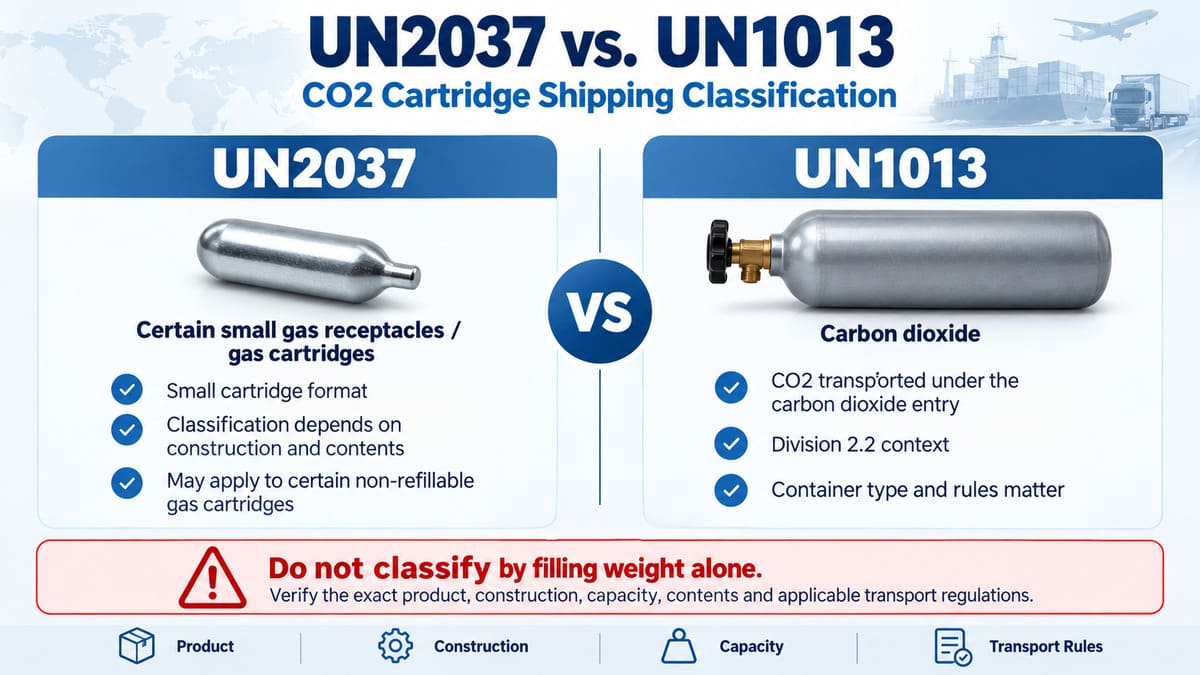
| Comparison | UN2037 | UN1013 |
|---|---|---|
| General description | Certain small gas receptacles or gas cartridges | Carbon dioxide |
| Typical product context | Eligible small gas cartridges | CO2 transported under the carbon dioxide entry |
| Relevant hazard division | Depends on contents; applicable non-flammable gas entries may be Division 2.2 | Division 2.2 |
| Main classification considerations | Cartridge construction, capacity, contents, release device, applicable conditions | CO2 and the applicable container and transport requirements |
| Automatically applies to all Fairdale cartridges? | No | No |
| Required buyer action | Verify the specific product and regulations | Verify the specific product and regulations |
Important: This comparison explains the general distinction between the two entries. It is not a substitute for an official classification decision for a particular shipment.
Before shipping CO2 cartridges internationally, distributors should ask the manufacturer or qualified dangerous goods specialist to establish the correct transport description.
The assessment should address:
1. Product identification
Confirm the exact cartridge model, contents, intended use, and technical specifications.
2. Container construction
Identify whether the cartridge is refillable or non-refillable and whether it contains a release device.
3. Water capacity and filling information
Provide the applicable container capacity and gas filling details.
4. Transport mode
Identify whether the shipment will travel by sea, air, road, or a combination of modes.
5. Applicable transport regulations
Review the current dangerous goods list, special provisions, packaging instructions, and possible exceptions.
6. Carrier requirements
Confirm that the intended carrier accepts the proposed cargo under the applicable conditions.
Shippers should retain the relevant classification information and supporting documents for reference.
Some dangerous goods regulations provide simplified requirements or exceptions for products that meet particular conditions.
However, these provisions are not interchangeable across transport modes.
An exception available under one country's domestic road transportation rules may not apply to an international air shipment.
Likewise, a provision concerning small gas receptacles does not mean that every cartridge below a particular filling weight can be shipped without restrictions.
Distributors should never assume that all 12g or 16g cartridges automatically qualify for limited quantity treatment.
The correct approach is to verify the applicable entry, special provisions, capacity conditions, packaging requirements, and carrier acceptance for the exact shipment.
Different transportation modes operate under different dangerous goods regulatory frameworks.
When shipping CO2 cartridges from China to overseas distributors, the applicable rules may change as the shipment moves between sea, air, and road transportation.
International maritime shipments of packaged dangerous goods are governed by the International Maritime Dangerous Goods Code, commonly called the IMDG Code.
The International Maritime Organization (IMO) develops and maintains this framework.
The IMDG Code addresses requirements involving:
Dangerous goods classification.
Proper shipping names and UN numbers.
Packaging.
Marking and labeling.
Shipping documentation.
Stowage and segregation.
Cargo transport units.
Other relevant maritime safety measures.
The IMDG Code 2024 Edition, incorporating Amendment 42-24, became mandatory on January 1, 2026.
Importers can consult the IMO's official IMDG Code information.
Before arranging sea freight, verify the current requirements and obtain confirmation from the shipping line or its authorized booking agent.
International air transportation is subject to strict dangerous goods requirements.
The International Civil Aviation Organization (ICAO) establishes the relevant Technical Instructions, while the International Air Transport Association (IATA) publishes the widely used Dangerous Goods Regulations.
The IATA DGR provides detailed requirements concerning classification, packing, labeling, documentation, and operator acceptance.
The 67th edition applies in 2026, together with relevant amendments and addenda.
Official information is available through the IATA Dangerous Goods Regulations.
Air transportation requirements may differ from maritime requirements.
A cartridge accepted for sea freight is not automatically eligible for air transportation.
Additional airline restrictions and operator variations may also apply.
Many international CO2 cartridge shipments include road transport before arriving at the departure port or after entering the destination country.
Different road transport rules may apply.
For example:
European international road transportation may be subject to ADR.
Relevant U.S. domestic transportation may be subject to 49 CFR Parts 171–180.
Other countries may operate their own domestic dangerous goods transport systems.
The United Nations Economic Commission for Europe publishes the ADR regulations for international carriage of dangerous goods by road.
Importers should confirm that the planned transport arrangements comply with the rules applicable to each stage of the route.
Preparing the correct documents is essential for international CO2 cartridge shipments.
Missing or inconsistent information can lead to freight rejection, customs delays, additional charges, or requests for clarification.
The exact document requirements depend on the product, transportation mode, destination, classification, and any applicable regulatory exceptions.
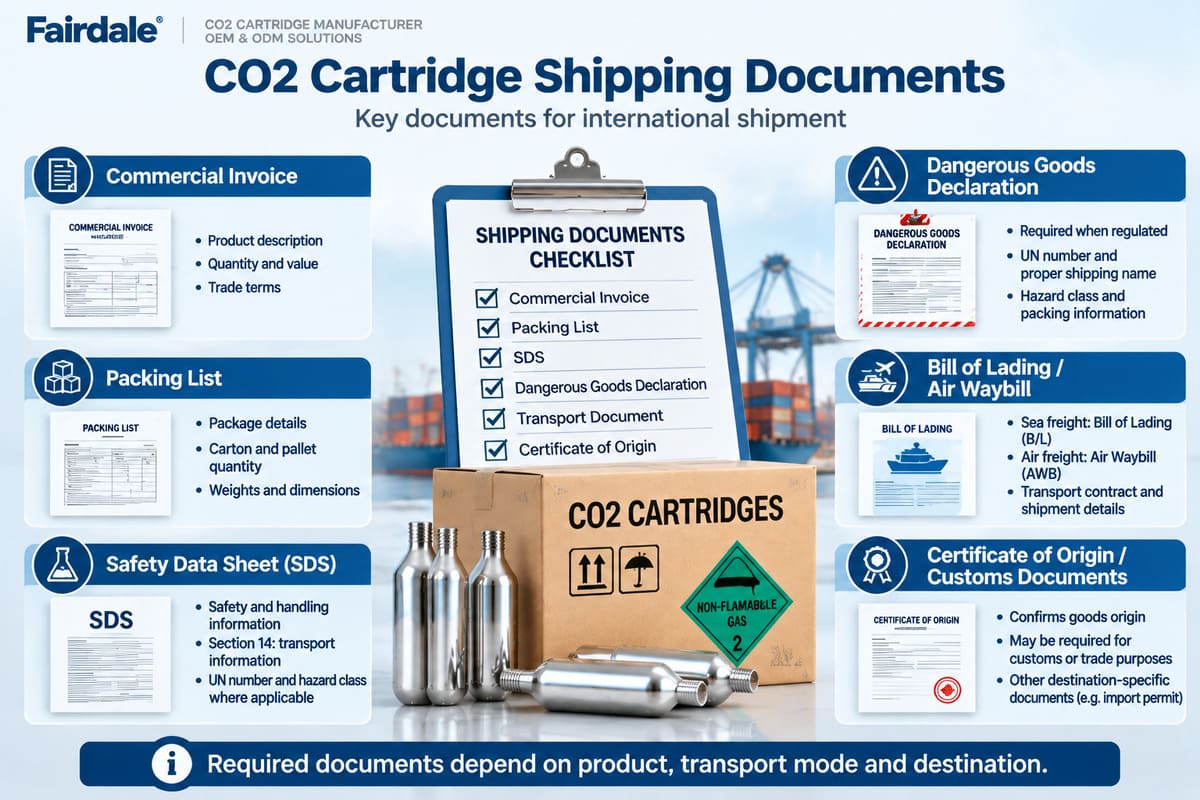
Most international commercial shipments require standard trade and transportation documents.
| Document | Main purpose | When to confirm |
|---|---|---|
| Commercial Invoice | Product description, commercial value, and transaction information | Before export and customs clearance |
| Packing List | Package quantities, weights, and dimensions | Before shipment |
| Bill of Lading | Sea freight transportation document | According to ocean carrier arrangements |
| Air Waybill | Air freight transportation document | According to air cargo arrangements |
| Certificate of Origin | Supports origin-related requirements | When required for customs or commercial purposes |
| Import Permits or Other Customs Documents | Meets destination-specific requirements | Before arrival or when required by local rules |
Product descriptions and quantities should be consistent across the relevant documents.
For example, the commercial invoice and packing list should identify the actual merchandise accurately rather than relying on an overly general description such as "metal accessories."
A Safety Data Sheet (SDS), sometimes called an MSDS, provides safety-related information concerning a substance or product.
SDS Section 14 is typically used to present transport information, which may include:
UN number.
Proper shipping name.
Transport hazard class.
Other relevant transportation information.
Special precautions.
The precise information provided may depend on the SDS and applicable requirements.
Importers can review the general SDS format through the U.S. Occupational Safety and Health Administration's SDS guidance.
An SDS is valuable supporting information, but it does not automatically replace shipping documents required under dangerous goods transport regulations.
No.
An SDS and a Dangerous Goods Declaration serve different purposes.
An SDS communicates safety information and may assist with transport classification review.
A Dangerous Goods Declaration is used to provide specified shipment information under the applicable transportation regulations when such a declaration is required.
For air cargo, the IATA Shipper's Declaration guidance explains the role of the declaration in regulated dangerous goods shipments.
Maritime transport has its own documentation requirements under the IMDG Code.
Depending on the transport mode and applicable provisions, additional packing declarations or cargo transport unit documentation may also be required.
Do not assume that presenting an SDS alone establishes compliance with every shipping requirement.
Freight forwarders, carriers, or importers may also request technical supporting information.
Depending on the shipment, this may include:
Product specification sheets.
Technical drawings.
Relevant test or inspection documentation.
Transport classification evidence.
Product conformity documents where applicable.
Packaging information.
Batch or product identification information.
These documents serve different purposes and should not all be described as mandatory for every shipment.
Before submitting a booking request, confirm the following.
| Information or document | Responsible party to coordinate with |
|---|---|
| Exact cartridge description and specifications | Manufacturer |
| Transport classification | Qualified shipper or dangerous goods specialist |
| SDS or other safety information | Supplier or responsible issuer |
| Commercial invoice and packing list | Exporter |
| Dangerous goods declaration, when required | Qualified shipper |
| Packaging and marking information | Shipper and packaging specialist |
| Carrier acceptance | Freight forwarder and carrier |
| Customs classification and destination documents | Importer and customs broker |
Completing this document review before dispatch can reduce the likelihood of last-minute problems.
Packaging is another critical part of international CO2 cartridge shipping.
Because cartridges contain pressurized gas, they must be protected from damage and packed according to the applicable transport requirements.
Suitable export packaging should consider both physical product protection and regulatory compliance.
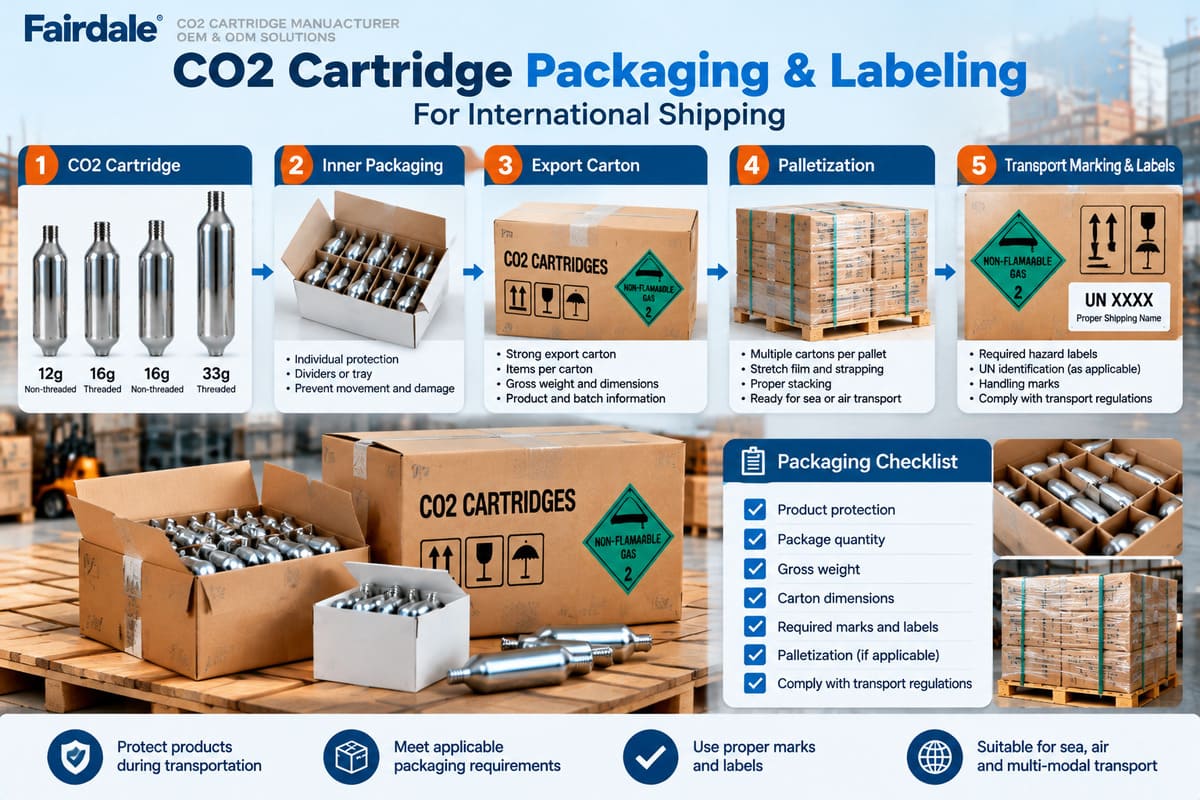
Inner packaging helps protect cartridges during handling and transportation.
Depending on the applicable transport provisions and approved packaging configuration, it may help prevent:
Movement and impact between cartridges.
Damage to cartridge necks or threaded connections.
Accidental activation of a release mechanism, where relevant.
Damage caused by contact with other packed items.
Packaging deterioration during normal transportation.
The appropriate internal arrangement depends on the cartridge and applicable packaging instructions.
For example, a small unthreaded cartridge and a larger threaded cartridge may require different protective arrangements.
Inner packaging should be evaluated as part of the complete shipment packaging configuration.
For wholesale orders, CO2 cartridges may be packed in outer cartons and consolidated onto pallets where permitted.
Distributors should confirm the following information:
Number of cartridges per package.
Number of cartons per pallet.
Net and gross weights.
Carton dimensions.
Pallet dimensions.
Package identification.
Product and batch traceability.
Required transport packaging standards.
Applicable stacking and handling limitations.
For certain dangerous goods shipments, the applicable regulations may require specification packaging or other defined packaging arrangements.
Not every shipment uses the same packaging instructions.
Packaging requirements must be determined according to the applicable dangerous goods entry, transport mode, and any relevant provisions.
Dangerous goods packaging may require specific labels and markings.
Depending on the shipment, these can include:
UN identification information.
Proper shipping name.
Applicable hazard labels.
Required package markings.
Overpack markings, where applicable.
Other transport-specific identification.
The exact requirements depend on the transport classification and applicable provisions.
Importantly, ordinary retail product labels are not necessarily the same as transport hazard labels.
Customized retail packaging also does not automatically satisfy dangerous goods shipping requirements.
Distributors purchasing private-label cartridges should discuss transportation requirements alongside retail packaging design.
For example, a branded retail box may be suitable for displaying products in stores, but the complete shipment may require additional protective outer packaging and transport markings.
Fairdale offers CO2 cartridge OEM and packaging services, including bulk packaging and customized retail packaging arrangements.
The final packaging configuration should be reviewed against the relevant cartridge specifications and applicable transport requirements before production.
Practical recommendation: Confirm shipping packaging and labeling requirements before approving final OEM packaging artwork.
Sea freight is commonly considered for larger wholesale CO2 cartridge orders.
It can be commercially attractive when distributors are purchasing regular inventory replenishment quantities, although actual costs depend on shipment size, carrier acceptance, route, and handling requirements.
Two common commercial sea freight arrangements are Full Container Load (FCL) and Less than Container Load (LCL).
FCL — Full Container Load
An FCL arrangement generally involves booking a container for a particular shipment.
It may be considered when shipping larger quantities or when cargo handling arrangements make a dedicated container preferable.
LCL — Less than Container Load
LCL consolidates cargo from multiple shippers into a shared container.
This arrangement may be considered for smaller commercial quantities.
However, dangerous goods acceptance can be more restrictive for consolidated cargo, and availability depends on the carrier, consolidation operator, classification, routing, and applicable rules.
Distributors should not assume that every CO2 cartridge shipment can be transported as LCL cargo.
Before booking a shipment, the forwarder may request technical and commercial information such as:
Product name and description.
UN number and proper shipping name.
Hazard division.
Relevant special provisions.
Package quantity and gross weight.
Packaging configuration.
Origin and destination ports.
Expected cargo readiness date.
Supporting documents.
The carrier may review this information before confirming acceptance.
Booking confirmation should be obtained before committing to a departure schedule.
A practical sea freight preparation process includes the following stages.
Step 1: Confirm the product
Review the exact CO2 cartridge model and shipping classification.
Step 2: Verify packaging
Confirm that the planned packaging meets the applicable transport requirements.
Step 3: Prepare documents
Provide commercial and dangerous goods information according to the carrier's requirements.
Step 4: Obtain booking acceptance
Confirm that the selected shipping line accepts the shipment.
Step 5: Arrange cargo delivery
Coordinate delivery to the appropriate warehouse, terminal, or other designated location.
Step 6: Complete export and transport procedures
Finalize the required documentation and follow the approved shipping arrangement.
Distributors should also confirm the destination port's handling requirements and estimated local charges before shipment.
Air freight can be useful for urgent shipments, but compressed gas products may face significant transport restrictions.
A small physical size does not automatically mean that a CO2 cartridge is suitable for air transportation.
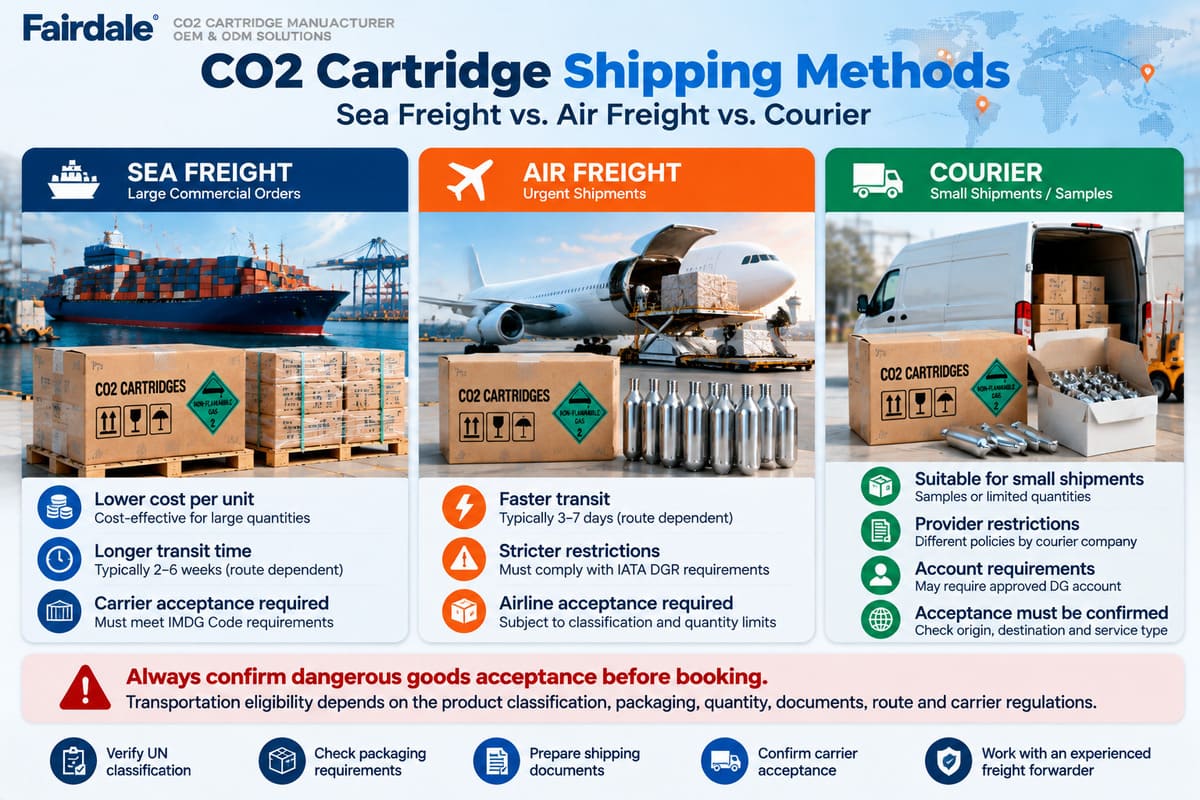
The eligibility of CO2 cartridges for air transportation depends on the applicable dangerous goods regulations, product configuration, packaging, quantity, and carrier restrictions.
Some shipments may be accepted when they meet the relevant conditions.
Others may be restricted or prohibited under the proposed arrangement.
Before requesting an air freight quotation, confirm:
The correct air transport classification.
Applicable packing instructions.
Permitted quantities and relevant limitations.
Required markings and labels.
Shipping documentation.
Airline or operator restrictions.
Acceptance at the origin and destination airports.
The applicable edition of the IATA Dangerous Goods Regulations should be consulted.
Do not assume that regulations concerning gas cartridges carried by airline passengers automatically apply to commercial air cargo.
Passenger baggage provisions and cargo shipment requirements are separate matters.
Importers often request samples before placing a wholesale order.
However, small sample shipments may still be subject to dangerous goods rules.
For example, a sample package containing a few 12g cartridges should not automatically be treated as ordinary merchandise.
The correct transportation arrangement depends on the actual shipment and applicable provisions.
Distributors should inform the supplier and freight forwarder that the samples contain pressurized gas.
Never describe filled CO2 cartridges as empty metal parts or ordinary accessories to avoid shipping restrictions.
Courier services may impose additional restrictions on dangerous goods.
Some providers may accept certain regulated shipments only through approved accounts or designated service arrangements.
Acceptance can depend on:
Product classification.
Origin and destination.
Service type.
Packaging configuration.
Account authorization.
Applicable legal requirements.
Buyers should request written confirmation before arranging courier collection.
| Method | Typical commercial consideration | Main limitation |
|---|---|---|
| Sea freight | Often considered for larger commercial quantities | Dangerous goods acceptance and maritime shipping requirements |
| Air freight | Faster option when permitted | Strict packing, documentation, airline, and quantity restrictions |
| Courier | May suit certain accepted small shipments | Provider-specific restrictions and limited service availability |
Buyer recommendation: Choose the transportation method after confirming product classification and carrier acceptance, not solely on the basis of quoted transit time.
The cost of shipping CO2 cartridges internationally varies according to the product, quantity, transport mode, destination, and regulatory requirements.
Unlike ordinary consumer goods, some pressurized gas shipments may involve additional dangerous goods handling and documentation costs.
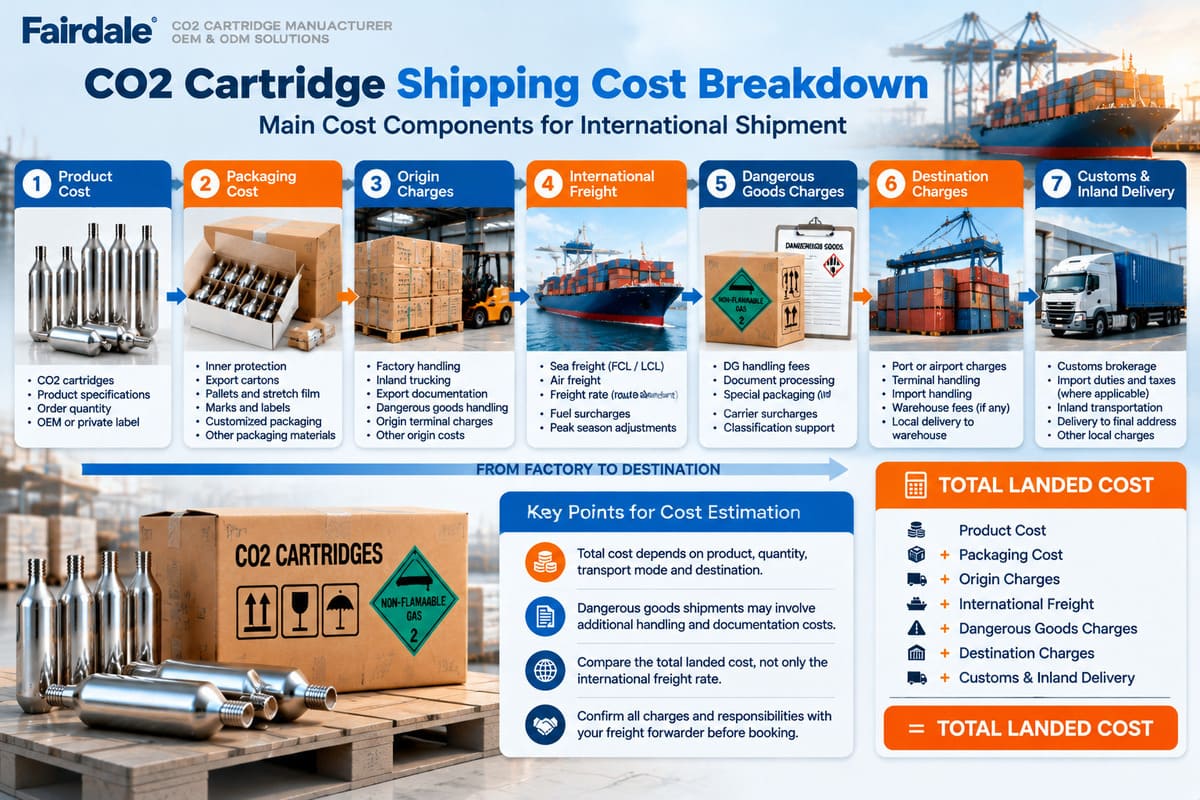
A shipping quotation may include:
International freight.
Origin handling.
Dangerous goods handling surcharges.
Documentation charges.
Cargo insurance.
Terminal handling.
Destination handling.
Customs brokerage.
Inland delivery.
Storage or other charges if delays occur.
Not every cost applies to every shipment.
Distributors should request a detailed quotation that identifies included and excluded charges.
International quotations commonly use Incoterms to define delivery and cost responsibilities.
| Incoterm | General meaning | Important consideration |
|---|---|---|
| FCA | Seller delivers to the nominated carrier or party at the agreed place | Suitable for various transport modes |
| FOB | Seller delivers goods on board a vessel at the named port | Intended for sea or inland waterway transport |
| CIF | Seller arranges freight and required insurance to the named destination port | Buyer must understand risk transfer and destination charges |
| DAP | Seller delivers to the named destination, ready for unloading | Import clearance and applicable import duties generally remain with the buyer |
The quotation should identify the named location and agreed Incoterms edition.
For example, "FOB" without a named port is less precise than a complete contractual delivery term.
FCA may be appropriate for certain multimodal or containerized arrangements, depending on how the goods are handed over.
Incoterms do not replace dangerous goods transportation requirements.
When comparing forwarders, consider more than the headline freight rate.
| Comparison item | Forwarder A | Forwarder B |
|---|---|---|
| Accepted transport classification | Confirm | Confirm |
| Carrier acceptance | Confirm | Confirm |
| Main freight charge | Request quote | Request quote |
| Dangerous goods charges | Request breakdown | Request breakdown |
| Origin charges | Check inclusions | Check inclusions |
| Destination charges | Check exclusions | Check exclusions |
| Documentation support | Confirm scope | Confirm scope |
| Estimated transit time | Route-specific | Route-specific |
| Cargo insurance | Confirm terms | Confirm terms |
A lower freight rate may not be the better option if important destination charges or dangerous goods fees are excluded.
The final purchasing decision should consider cost transparency, regulatory competence, and delivery reliability.
Choosing an experienced freight forwarder is particularly important when importing pressurized gas cartridges.
A suitable forwarder should understand the applicable dangerous goods requirements and be able to coordinate acceptance with the carrier.
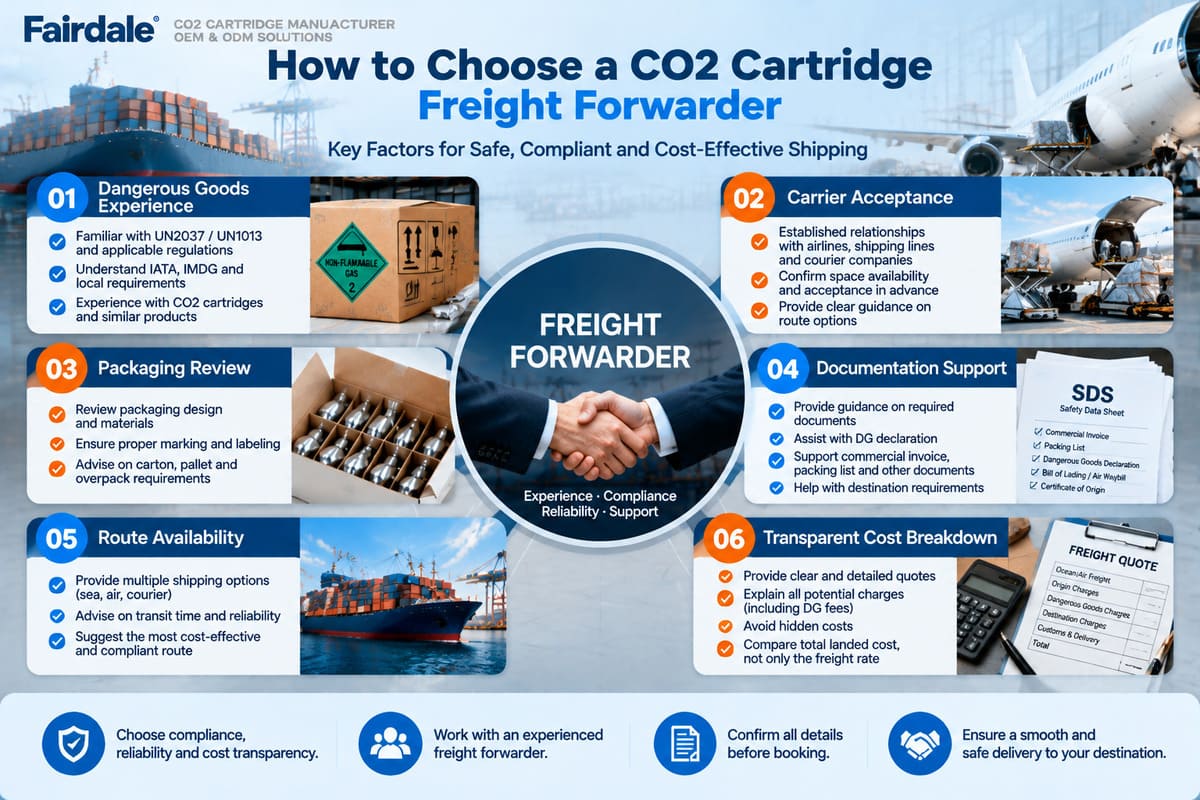
Before selecting a logistics partner, ask:
Have you handled shipments with this proposed dangerous goods classification?
Which carriers and routes are available for this specific cargo?
Can you review the packaging and documentation requirements?
Are any special approvals or handling arrangements necessary?
Are FCL, LCL, or air freight options available for this shipment?
What charges are included in your quotation?
What could cause a booking to be rejected?
How will changes to the shipping schedule be communicated?
A reliable logistics provider should explain which facts have been confirmed and which still require review.
Avoid relying on general assurances such as "all CO2 cartridges can be shipped worldwide."
When requesting a freight quotation, prepare a clear shipment information summary.
| Information | Example or required detail |
|---|---|
| Product | Filled CO2 cartridges |
| Application | Airgun, bicycle inflation, life jacket, or other |
| Cartridge model | Exact SKU or specification |
| Gas filling weight | Confirmed nominal CO2 fill |
| Water capacity | Model-specific information |
| Transport classification | Verified UN number and shipping description |
| Total quantity | Number of cartridges |
| Packaging | Units per carton and pallet arrangement |
| Gross weight | Confirmed shipment weight |
| Origin | Factory or dispatch location in China |
| Destination | Port, airport, or delivery address |
| Cargo ready date | Expected availability |
| Required services | Freight, documentation, customs, or inland delivery |
The manufacturer can provide product-specific information, but the parties responsible for classification, declarations, and transport must fulfill their respective obligations.
The carrier ultimately determines acceptance under its applicable policies and regulatory requirements.
International distributors can reduce unnecessary delays by identifying common shipping mistakes before production or dispatch.
| Common mistake | Possible consequence | Recommended action |
|---|---|---|
| Assuming all CO2 cartridges are UN1013 | Incorrect shipping classification | Verify the exact product and applicable entry |
| Assuming all small cartridges are UN2037 | Incorrect classification or exception claim | Review construction, capacity, contents, and regulations |
| Treating SDS as complete shipping approval | Missing transport documents | Check the full document requirements |
| Booking freight after production | Carrier rejection or storage delays | Confirm feasibility before production |
| Using unsuitable outer packaging | Transport noncompliance or product damage | Follow applicable packaging requirements |
| Applying unverified hazard labels | Incorrect package identification | Confirm required marks and labels |
| Assuming samples are exempt | Courier or air freight rejection | Verify sample shipment conditions |
| Ignoring destination charges | Unexpected landed costs | Request a detailed freight breakdown |
| Relying on passenger baggage rules for cargo | Incorrect air freight assumptions | Review commercial cargo requirements |
| Selecting freight solely by price | Service or compliance problems | Evaluate carrier acceptance and forwarder experience |
The most effective way to reduce shipping risk is to establish a clear review process before every new cartridge configuration or route is used.
Use the following checklist before arranging an international CO2 cartridge shipment.
Confirm the destination country and intended application.
Identify the exact cartridge model.
Confirm gas filling weight and water capacity.
Review the container construction and technical specification.
Verify the applicable transport classification.
Identify transport-mode restrictions.
Confirm preliminary carrier acceptance or shipping feasibility.
Review applicable packaging requirements.
Confirm the shipping method.
Prepare the correct product and classification information.
Check the relevant SDS and supporting documents.
Confirm any required dangerous goods declarations.
Verify carton quantity, dimensions, and gross weight.
Review package marks and labels.
Obtain a detailed freight quotation.
Confirm the delivery terms and responsibilities.
Verify that the finished goods match the approved specifications.
Confirm the packaging arrangement.
Check invoice and packing list consistency.
Confirm carrier acceptance and booking details.
Review any required shipment declarations.
Confirm cargo pickup or delivery arrangements.
Provide the required documents to the importer and customs broker.
Retain the relevant records for future orders.
A documented pre-shipment checklist is particularly useful for distributors managing repeat wholesale orders or multiple cartridge configurations.
It can improve communication between buyers, manufacturers, freight forwarders, and customs brokers.
CO2 cartridges are commonly regulated as dangerous goods during transportation because they contain pressurized gas.
Depending on the product, an applicable entry may involve UN2037 or another relevant classification.
The correct classification depends on the actual container and transport regulations.
Distributors should verify the UN number, proper shipping name, hazard division, and applicable provisions before shipping.
UN2037 applies to certain small gas receptacles and gas cartridges meeting the relevant criteria.
UN1013 identifies carbon dioxide transported under the applicable carbon dioxide entry.
These entries serve different classification purposes and should not be used interchangeably.
The correct entry must be determined from the product construction, contents, capacity, and applicable transport rules.
Yes, commercial CO2 cartridge shipments may be transported internationally when the products and transportation arrangements meet applicable requirements.
However, acceptance depends on the shipment's classification, packaging, documentation, transportation mode, route, and carrier policies.
Importers should obtain confirmation from qualified logistics providers before arranging shipment.
Air shipment may be possible for certain 12g CO2 cartridge configurations when all applicable dangerous goods regulations and carrier conditions are met.
However, the nominal 12g filling weight alone does not establish eligibility.
Buyers must confirm the air transport classification, packaging instructions, quantity limitations, documentation, and airline acceptance.
Common commercial documents include a commercial invoice, packing list, and applicable transport document.
Additional documents may include an SDS, dangerous goods declaration, transport classification information, and other relevant supporting records.
The exact requirements depend on the product, destination, transport mode, and applicable provisions.
No. An SDS provides relevant safety information and may assist with classification review, but it is not a universal substitute for dangerous goods declarations, compliant packaging, or carrier acceptance.
Before shipping, the responsible parties must confirm all documentation and transport requirements applicable to the shipment.
CO2 cartridges can be shipped by sea when the products are properly classified and the shipment satisfies the relevant IMDG Code and carrier requirements.
FCL or LCL options may be available depending on the cargo, route, and operator acceptance.
Distributors should confirm packaging, documents, booking conditions, and destination charges before dispatch.
Distributors should first identify the exact cartridge model and confirm its shipping classification.
They should then coordinate packaging, documentation, carrier acceptance, commercial terms, and customs arrangements.
A pre-shipment checklist helps verify that product information, package quantities, transport documents, and delivery arrangements are consistent before the goods leave the factory.
International CO2 cartridge sourcing involves more than choosing the correct product capacity.
For distributors and wholesalers, it is equally important to coordinate product specifications, packaging requirements, shipping documentation, and commercial delivery arrangements.
Changzhou Fairdale Metal Tools Co., Ltd. is a China-based manufacturer specializing in miniature CO2 cartridges and related gas cylinder products.
Fairdale supplies CO2 cartridges for applications including compatible airguns, bicycle tire inflation systems, beverage equipment, inflatable life jackets, and protective airbag equipment.
The company also supports OEM and wholesale projects involving product specifications, packaging requirements, and export coordination.
You can learn more about Fairdale's manufacturing capabilities and its OEM, packaging, and export support services.
Shipping arrangements and regulatory requirements must be confirmed for the specific product and destination, with the relevant shipping responsibilities coordinated among the parties involved.
If you are planning a commercial CO2 cartridge order, provide the following information when contacting Fairdale:
Cartridge size and intended application.
Required product specifications.
Estimated order quantity.
Packaging or OEM requirements.
Destination country.
Preferred delivery terms.
Any known documentation or regulatory requirements.
Contact Fairdale to Request a Wholesale CO2 Cartridge Quote
Our team can review your product and commercial requirements and discuss the information needed to support your sourcing project.
Regulatory note: This article provides general information for distributors and importers. Dangerous goods classification, packaging, marking, documentation, and transportation requirements depend on the specific product, applicable regulations, transport mode, and destination. Always confirm the current requirements with qualified dangerous goods specialists, relevant authorities, freight forwarders, and carriers before arranging a shipment.
Regulatory references: PHMSA Hazardous Materials Interpretation · IMO IMDG Code · IATA Dangerous Goods Regulations · UNECE ADR · OSHA Safety Data Sheets


