English


Views: 0 Author: Site Editor Publish Time: 2026-10-12 Origin: Site
Importing CO2 cartridges from China can help distributors, wholesalers, and private-label brands establish a competitive and reliable supply chain. However, purchasing pressurized gas cartridges internationally involves more than comparing factory prices.
Buyers must evaluate cartridge specifications, manufacturer capabilities, quality control, dangerous goods regulations, shipping arrangements, customs documentation, and total landed costs before confirming an order.
Different applications also require different cartridge configurations. A 12g CO2 cartridge used in an airgun is not interchangeable with a 16g cartridge designed for bicycle inflation. Even cartridges containing the same amount of CO2 may have different threads, dimensions, and equipment compatibility requirements.
For example, Fairdale manufactures different 33g CO2 cartridge configurations for inflatable life jackets and compatible beauty-gun equipment, with distinct threaded connections for each application.
Whether you are importing standard cartridges for wholesale distribution or developing a private-label product line, understanding these differences can help prevent costly purchasing mistakes.
This guide explains how to import CO2 cartridges from China, covering supplier selection, technical specifications, international shipping regulations, import documentation, customs clearance, wholesale costs, and OEM sourcing.
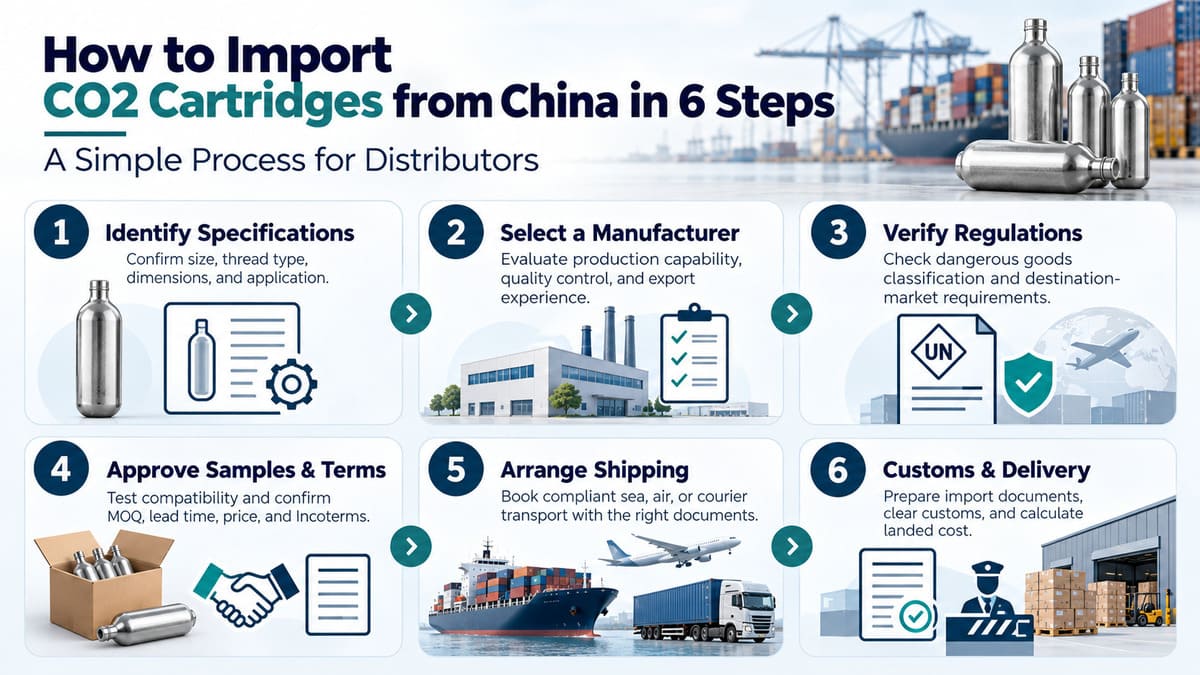
To import CO2 cartridges from China, distributors should follow six essential steps:
Choose the correct CO2 cartridge specifications. Confirm the required gas capacity, cartridge dimensions, thread type, intended application, and packaging.
Find a qualified Chinese manufacturer. Evaluate production capabilities, product consistency, quality control procedures, and export experience.
Verify import and safety requirements. Identify the applicable dangerous goods classification, destination-market regulations, and product conformity requirements.
Approve samples and commercial terms. Test product compatibility and confirm pricing, MOQ, production lead time, and Incoterms.
Arrange compliant international shipping. Work with a qualified freight forwarder that can handle the specific pressurized gas cartridges.
Complete customs clearance and delivery. Prepare the necessary import documents, verify tariff classification, and calculate your total landed cost.
For first-time importers, the most important step is to confirm product compatibility, regulatory requirements, and shipping feasibility before mass production begins.
Doing so can help avoid shipment rejection, unexpected costs, product returns, and inventory that cannot legally be sold in the destination market.
CO2 cartridges are compact, pressurized containers that store carbon dioxide for use in compatible equipment.
They are commonly found in airguns, bicycle tire inflators, beverage systems, inflatable life jackets, protective airbag equipment, and certain industrial devices.
For distributors, understanding cartridge specifications is essential because different applications require different gas capacities, connection types, and equipment compatibility.
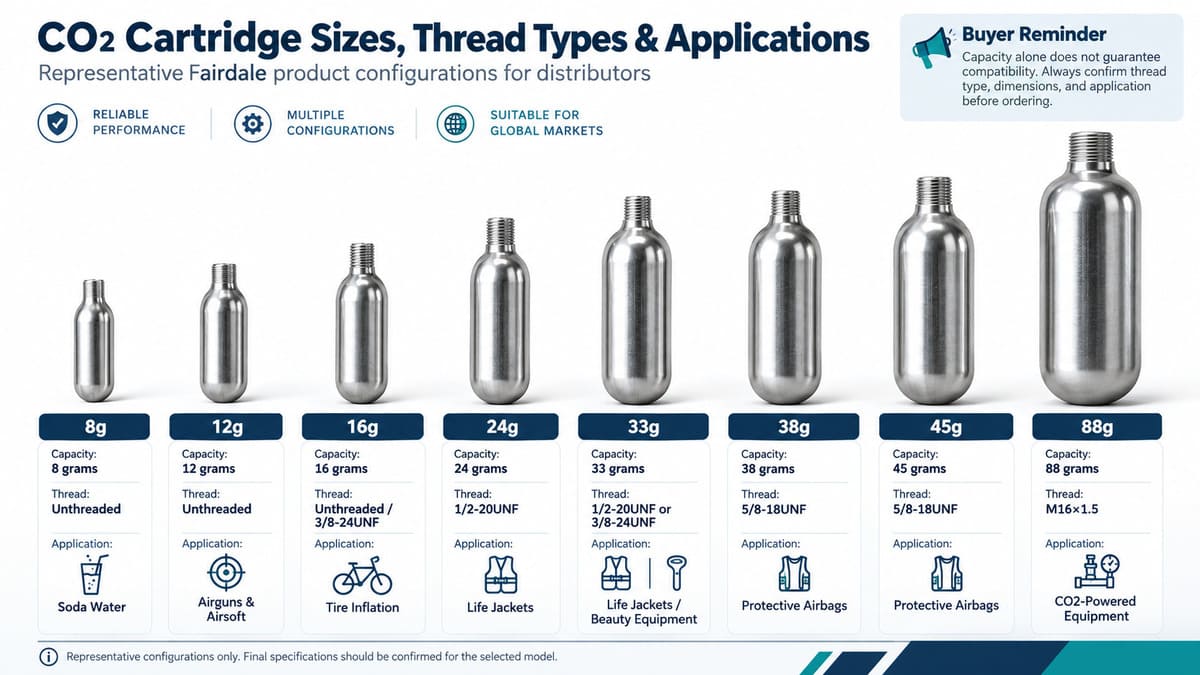
Manufacturers in China supply CO2 cartridges in a wide range of sizes.
Fairdale's product catalog includes miniature CO2 cartridges for several commercial applications, with representative configurations shown below.
| CO2 capacity | Typical application | Representative thread type |
|---|---|---|
| 8g | Compatible soda water machines | Unthreaded |
| 12g | Airguns, airsoft, and compatible paintball equipment | Unthreaded |
| 16g | Bicycle tire inflators and compatible accessories | Unthreaded or 3/8-24UNF |
| 24g | Inflatable life jackets | 1/2-20UNF |
| 33g | Inflatable life jackets | 1/2-20UNF |
| 33g | Compatible Coolifting beauty-gun equipment | 3/8-24UNF |
| 38g | Compatible motorcycle and equestrian airbag equipment | 5/8-18UNF |
| 45g | Compatible motorcycle and equestrian airbag equipment | 5/8-18UNF |
| 88g | Compatible larger CO2-powered shooting equipment | M16×1.5 |
These are representative configurations from Fairdale's product catalog, not universal industry standards. Actual dimensions, connection specifications, approvals, and compatibility must be confirmed for the selected product.
Distributors can explore Fairdale's CO2 cartridge product range to review available cartridge categories.
For sporting goods distributors, 12g CO2 cartridges for airguns and airsoft are a common sourcing option.
Cycling accessory importers can evaluate 16g CO2 cartridges for tire inflation, while beverage equipment suppliers may require 8g CO2 cartridges for compatible soda water machines.
For marine safety applications, Fairdale supplies 24g CO2 cartridges and 33g CO2 cartridges for inflatable life jackets.
The manufacturer's range also includes 38g and 45g CO2 cartridges for compatible protective airbag equipment.
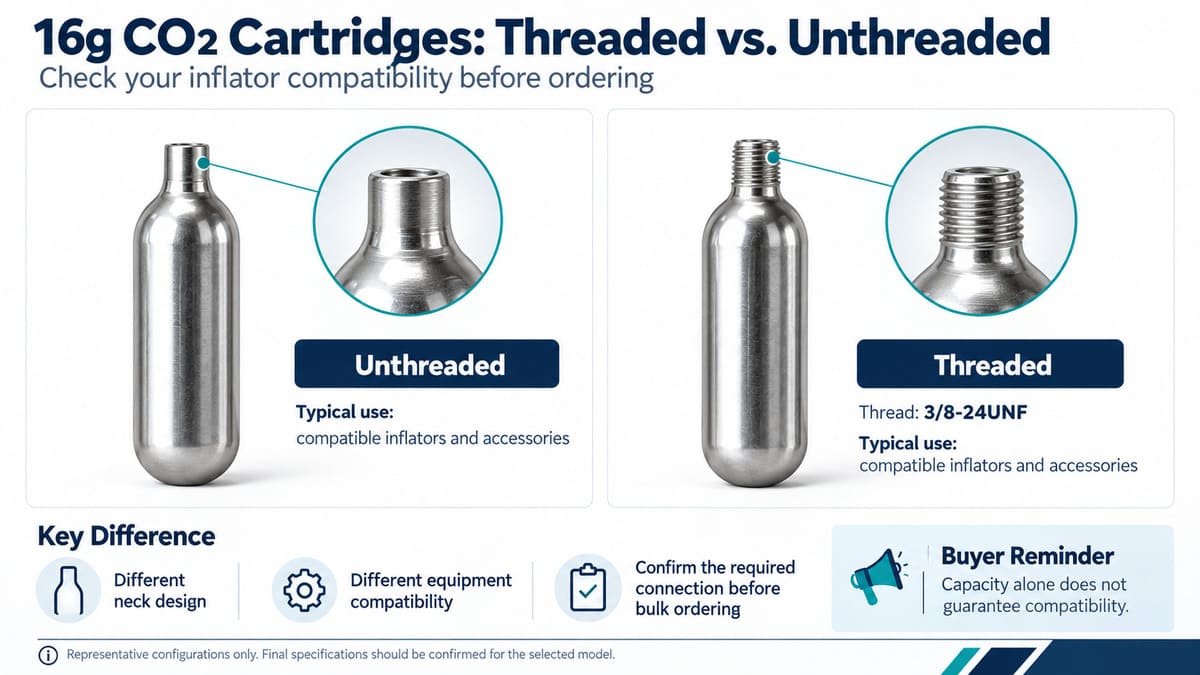
Connection design is one of the most important purchasing specifications.
Non-threaded CO2 cartridges typically operate in equipment that uses a puncture mechanism to release the gas.
For example, Fairdale's standard 12g airgun cartridge is an unthreaded model intended for compatible shooting equipment.
Threaded CO2 cartridges connect to compatible devices through a specific threaded interface.
Different cartridge applications may require different thread specifications, including 3/8-24UNF, 1/2-20UNF, 5/8-18UNF, or M16×1.5, depending on the product.
A particularly important example is Fairdale's 16g range, which includes both unthreaded and 3/8-24UNF threaded configurations.
Buyers should never assume that all 16g cartridges use the same connection.
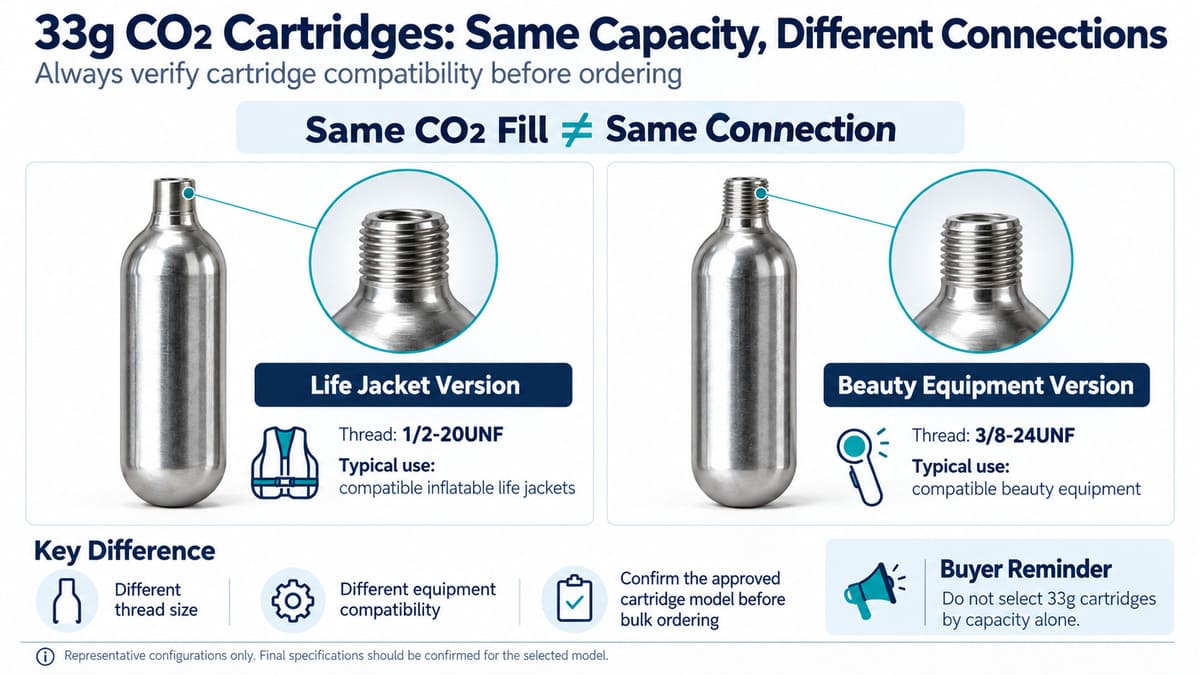
Consider two 33g CO2 cartridges supplied for different applications.
Fairdale's catalog identifies:
A 33g cartridge with a 1/2-20UNF thread for compatible inflatable life jackets.
A separate 33g cartridge with a 3/8-24UNF thread for compatible Coolifting beauty-gun equipment.
Although both contain a nominal 33g CO2 charge, their connections and intended uses are different.
They should not be treated as interchangeable products.
The same principle applies to life-jacket cartridges with different filling weights.
For example, 24g and 33g life-jacket cartridges may both use a 1/2-20UNF threaded connection, but their gas capacities and system requirements differ.
Distributor tip: Always verify the complete cartridge specification against the equipment manufacturer's requirements before placing a wholesale order.
The required CO2 gas quality depends on the application.
Cartridges intended for food or beverage equipment may require food-grade carbon dioxide and documentation supporting the applicable gas quality and material requirements.
Cartridges intended for airguns, bicycle inflation, or other applications may be subject to different specifications.
Buyers should ask the manufacturer for the gas grade, relevant analysis results, and applicable supporting documents.
Do not assume that a stated CO2 purity percentage automatically establishes food-grade compliance.
The appropriate requirements must be evaluated for the intended use and destination market.
Finding the right supplier is one of the most important steps when importing CO2 cartridges from China.
Because these are pressurized products, manufacturing consistency, technical specifications, quality assurance, and documentation are especially important.
A low purchasing price cannot compensate for incompatible cartridges, leaking products, or shipping difficulties.
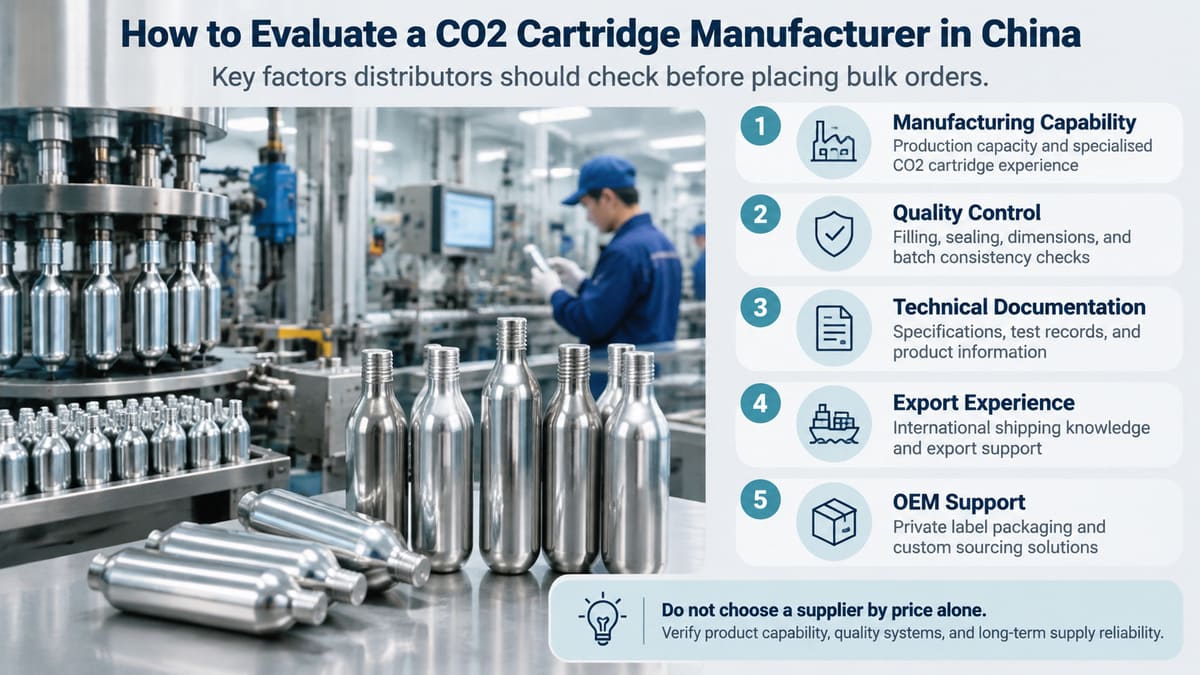
When sourcing from China, distributors usually encounter two types of suppliers.
Direct manufacturers operate production facilities and can provide information about manufacturing capabilities, product specifications, quality control procedures, and production capacity.
Trading companies source products from manufacturers and manage purchasing, supplier coordination, communication, and export services.
Both models can serve international buyers, but working directly with a manufacturer may offer advantages for technically specific or customized projects.
For example, buyers may find it easier to discuss cartridge dimensions, connection specifications, manufacturing tolerances, and product modifications directly with a factory.
However, buyers should still verify which production stages are performed internally and which are outsourced.
Before choosing a supplier, evaluate the following factors:
1. Relevant manufacturing experience
Look for experience producing cartridges for your intended application rather than relying only on general metalworking capabilities.
2. Clear technical specifications
A reliable supplier should be able to identify the proposed cartridge model, nominal filling weight, dimensions, thread type, and intended use.
3. Quality control procedures
Ask how filling weight, sealing, dimensions, and relevant pressure-related characteristics are verified.
4. Product conformity documentation
Request the applicable certificates, inspection records, and supporting technical documents for the particular model.
5. International shipping experience
Ask whether the supplier has experience preparing the relevant shipment documents and coordinating with dangerous goods freight forwarders.
6. Commercial supply capability
Evaluate production scheduling, MOQ, repeat-order consistency, and packaging requirements.
7. OEM and customization support
For private-label projects, confirm which specifications and packaging options can be evaluated and approved.
Founded in 2010 and located in Changzhou, Jiangsu Province, China, Changzhou Fairdale Metal Tools Co., Ltd. specializes in miniature CO2 cartridges and related gas cylinder products.
Its product catalog includes CO2 cartridges for compatible airguns, bicycle tire inflators, soda water machines, inflatable life jackets, protective airbag equipment, and other specialized applications.
For international distributors, this product range provides an opportunity to discuss different cartridge specifications and sourcing requirements with one manufacturing partner.
You can learn more about Fairdale's manufacturing background and company information.
Before selecting any supplier, buyers should still review current product specifications, samples, documentation, and commercial terms for the intended order.
Technical verification should take place before a distributor places a large commercial order.
Even cartridges with similar appearances can differ in dimensions, threads, gas capacity, or equipment compatibility.
Request a technical specification sheet covering the following details.
| Specification | What distributors should confirm |
|---|---|
| CO2 filling weight | Nominal gas charge and permitted tolerance |
| Water capacity | Container volume as specified for the model |
| Outside diameter | Compatibility with the intended device |
| Cartridge length | Overall dimensions and available installation space |
| Thread specification | Correct thread form and connection requirements |
| Cartridge material | Applicable material and construction specification |
| Surface treatment | Finish and corrosion protection requirements |
| Pressure-related test information | Applicable design and inspection requirements |
| Gas quality | Required CO2 grade and supporting evidence |
| Packaging | Units per pack, carton information, and protective packaging |
| Product identification | Model and batch-traceability requirements |
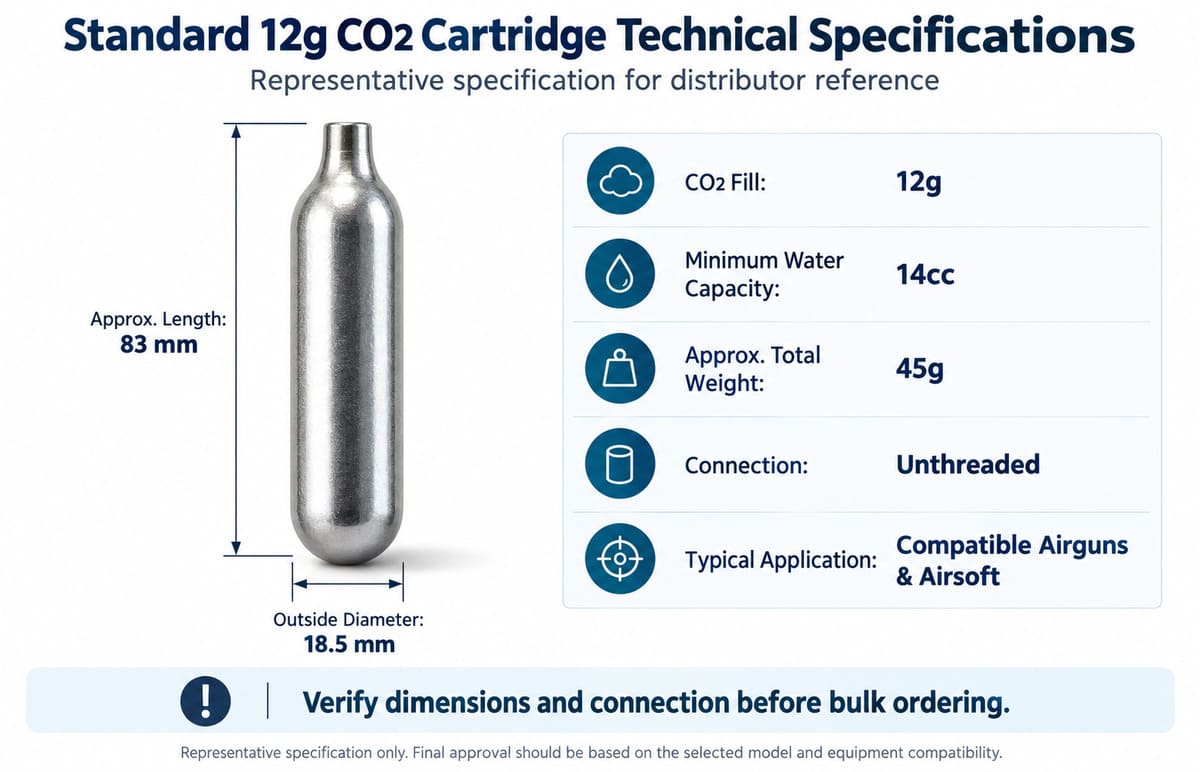
According to Fairdale's product catalog, a representative standard 12g cartridge has the following specifications.
| Parameter | Catalog specification |
|---|---|
| Nominal CO2 fill | 12g |
| Minimum water capacity | 14cc |
| Nominal outside diameter | 18.5mm |
| Approximate length | 83mm |
| Approximate total weight | 45g |
| Connection | Unthreaded |
| Main application | Compatible airguns and airsoft equipment |
These specifications provide a useful reference for distributors evaluating standard 12g products.
However, they should not be treated as proof of compatibility with every device designed to use a 12g cartridge.
For additional information about this product category, read Fairdale's 12g CO2 cartridge buying guide.
Physical samples help buyers evaluate whether the proposed cartridge meets their equipment and application requirements.
Depending on the product, sample evaluation may include:
Visual appearance and surface finish.
Filling weight verification.
Cartridge length and diameter measurements.
Thread inspection.
Installation and fit checks.
Leakage and sealing performance.
Functional testing in approved compatible equipment.
Review of relevant pressure-test documentation.
Packaging and labeling evaluation.
For cartridges used in inflatable life jackets or protective airbag systems, verification should follow the requirements of the complete inflation system and its manufacturer.
Approval based only on a matching thread size is insufficient.
Before dispatch, distributors should verify that the production batch matches the approved order specifications.
The inspection plan may cover product quantity, dimensions, filling-weight checks, appearance, markings, packaging, and relevant test records.
Where appropriate, independent third-party inspection can provide additional verification.
Inspection criteria and acceptance requirements should be agreed upon before production.
Practical recommendation: Keep an approved sample, signed technical specification, and agreed inspection checklist as reference documents for repeat orders.
Import regulations are among the most important factors when purchasing pressurized gas cartridges internationally.
Although CO2 is widely used in commercial equipment, the fact that a cartridge contains a familiar gas does not mean it is exempt from transport or product safety requirements.
Importers should distinguish between three separate regulatory questions:
How is the cartridge classified for dangerous goods transportation?
What technical and conformity requirements apply to the cartridge in the destination market?
Are there additional requirements based on its intended application?
These questions should be addressed separately.
Buyers importing CO2 cartridges may encounter different UN numbers in safety and shipping documents.
Two relevant entries are:
UN2037 — Small gas receptacles / gas cartridges
Certain small, non-refillable gas cartridges may be classified under UN2037 when the relevant conditions are met.
UN1013 — Carbon dioxide
UN1013 is the entry for carbon dioxide transported under the applicable gas classification, including certain cylinder shipments.
The correct classification depends on the actual product and the applicable transport regulations.
For example, cartridge design, capacity, contents, and the presence or absence of a release device can affect classification.
The U.S. Pipeline and Hazardous Materials Safety Administration (PHMSA) has provided guidance concerning the classification of certain non-refillable gas cartridges under UN2037.
Importers can consult the official PHMSA interpretation.
The interpretation illustrates classification principles, but it is not a classification certificate for Fairdale products.
Before booking transportation, confirm:
UN number and proper shipping name.
Hazard class or division.
Applicable special provisions or exemptions.
Packaging requirements.
Labeling and marking requirements.
Transport-mode limitations.
Carrier acceptance conditions.
Important: Do not assign a UN number solely from the CO2 filling weight or product name.
Distributors importing into the European Union should evaluate the relevant provisions of the Transportable Pressure Equipment Directive, Directive 2010/35/EU, together with the applicable transport regulations.
The directive expressly includes certain gas cartridges classified as UN2037 within its definition of transportable pressure equipment, while also establishing exclusions and conditions.
Where the directive applies, relevant requirements may include:
Conformity assessment.
Applicable technical documentation.
Importer and distributor responsibilities.
Product marking requirements.
Pi (π) conformity marking.
A common mistake is assuming that every CO2 cartridge simply requires a CE certificate.
In fact, the applicable conformity framework depends on the product and regulatory scope.
Distributors should refer to the EU Transportable Pressure Equipment Directive and obtain specialist advice where necessary.
For shipments entering or moving within the United States, the Hazardous Materials Regulations under 49 CFR Parts 171–180 may apply.
Relevant obligations can involve classification, packaging, marking, labeling, and shipping documentation.
Some small gas cartridges may qualify for particular exceptions, but only when the relevant conditions are satisfied.
Importers should not assume that a cartridge is exempt simply because it is small or intended for consumer equipment.
Confirm the requirements with the shipper, freight forwarder, and relevant regulatory specialists before transportation.
Great Britain operates a separate framework for transportable pressure equipment, including Rho marking provisions for equipment within the applicable scope.
Buyers should check the current UK government guidance on transportable pressure equipment.
Other countries may have different requirements concerning pressurized containers, import licensing, labeling, transportation, and product approvals.
A certificate accepted in one market should not automatically be assumed to satisfy another country's rules.
Additional requirements may apply to particular uses.
Beverage systems: Buyers may need evidence supporting food-grade gas quality and any applicable food-contact requirements.
Inflatable life jackets: Cartridge compatibility and relevant approval requirements must be considered alongside the complete inflation system.
Protective airbag equipment: Technical compatibility and requirements associated with the protective system should be verified.
Distributors should confirm the specific documentation required for their application instead of relying on generic statements such as "international certification available."
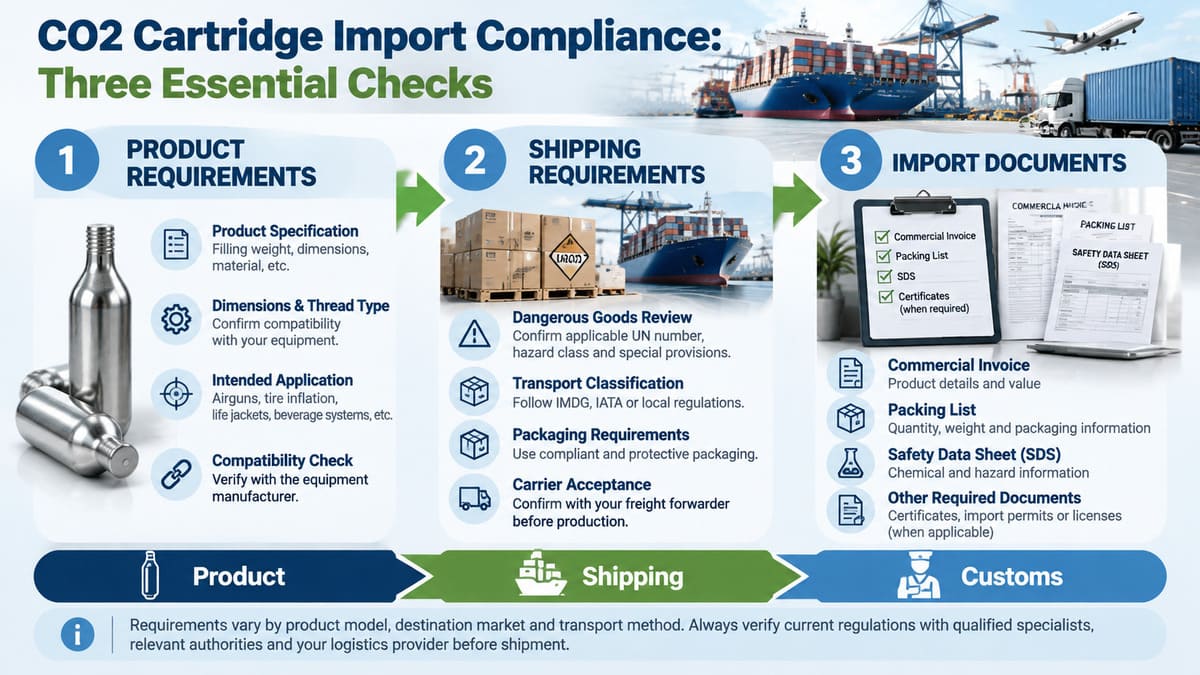
Correct documentation can help prevent transportation delays, customs problems, and disputes between buyers and suppliers.
The exact requirements depend on the product, destination country, transport classification, shipping method, and agreed commercial terms.
| Document | Main purpose |
|---|---|
| Commercial Invoice | Declares the products, quantities, commercial value, and transaction details |
| Packing List | Identifies packaging, quantities, weights, and shipment contents |
| Bill of Lading / Air Waybill | Provides the relevant transport record |
| Safety Data Sheet (SDS) | Communicates applicable chemical and hazard information |
| Dangerous Goods Declaration | Provides regulated shipment information when required |
| Product Specification Sheet | Describes cartridge dimensions, capacity, and other technical details |
| Applicable Test or Conformity Documents | Supports verification of product-specific requirements |
| Certificate of Origin | Supports origin and customs requirements where applicable |
| Import Permit or License | Meets destination-specific obligations when required |
Not every document is mandatory for every shipment.
For example, dangerous goods declaration requirements vary according to the mode of transport, classification, applicable exceptions, and shipment conditions.
An SDS should not be treated as a substitute for a product conformity certificate, transport classification assessment, or dangerous goods declaration.
Before the goods leave China, distributors should ask their customs broker and freight forwarder to review the relevant documents.
Check that the product description, quantity, weight, shipping details, and commercial value are consistent.
For larger or repeat orders, establishing a standard document-review process can reduce errors and improve shipping efficiency.
International shipping is one of the most important practical challenges when importing CO2 cartridges.
Because they are pressurized gas products, CO2 cartridges may be subject to dangerous goods transport requirements.
Not every freight company, airline, courier, or shipping route will accept every cartridge configuration.
Therefore, shipping arrangements should be confirmed before mass production.
| Shipping method | Typical use | Key considerations |
|---|---|---|
| Sea freight | Bulk wholesale orders and regular inventory replenishment | Dangerous goods acceptance, packaging, port arrangements, transit time |
| Air freight | Urgent commercial shipments when permitted | Strict acceptance rules, higher charges, quantity limitations |
| International courier | Certain small shipments accepted by the provider | Service restrictions, documentation, destination limitations |
Sea freight is often considered for large wholesale orders because it can offer more economical transportation than air freight.
However, maritime dangerous goods shipments must comply with the applicable International Maritime Dangerous Goods (IMDG) Code provisions.
The IMDG Code addresses dangerous goods classification, packing, marking, labeling, documentation, and related transport requirements.
Distributors can consult the International Maritime Organization's IMDG Code information.
Before confirming a shipment, verify that the relevant shipping line and any connecting carriers will accept the specific product and packaging arrangement.
Air shipment may be possible for certain CO2 cartridge configurations when the applicable regulatory conditions are satisfied.
However, air transport is subject to strict requirements.
The International Air Transport Association publishes the Dangerous Goods Regulations (IATA DGR), which provide widely used rules and guidance concerning classification, packaging, labeling, documentation, and airline acceptance.
Refer to the IATA Dangerous Goods Regulations.
Airline-specific restrictions may also apply.
It is not accurate to assume that all small cartridges can be shipped by air or that a particular gas capacity automatically qualifies for an exemption.
International courier companies may prohibit certain pressurized gas shipments or accept them only under approved service conditions.
Restrictions can vary by provider, country, packaging, and account arrangements.
Before sending product samples, verify whether the chosen courier accepts the shipment and which documents are required.
Appropriate packaging is essential for protecting cartridges and complying with transport requirements.
Depending on the shipment, the applicable requirements may include:
Suitable transport packaging.
Protection against physical damage.
Measures against accidental release.
Correct markings and hazard labels.
Accurate shipment weights and quantities.
Required dangerous goods documentation.
The appropriate packaging must be determined from the actual transport classification and applicable rules.
Strong cardboard cartons alone do not establish transport compliance.
When evaluating freight forwarders, ask the following questions:
Have you handled this cartridge type or UN classification before?
Can you confirm carrier acceptance before production?
What documents will be required?
Are there any route, port, or airline restrictions?
Which dangerous goods surcharges apply?
What destination charges are excluded from the quotation?
How will rejected or delayed shipments be handled?
A qualified freight forwarder should be able to explain the relevant requirements and identify any information still needed.
Distributor tip: Ask for a written shipping feasibility assessment before approving a large production order.
Customs clearance is another essential part of importing CO2 cartridges from China.
One of the most common questions from distributors is:
What is the correct HS code for CO2 cartridges?
The answer depends on the product characteristics and the customs classification rules of the importing country.
There is no single eight-digit or ten-digit tariff code that should be assumed to apply to every cartridge in every market.
Distributors should follow these steps:
Obtain a complete technical product description.
Identify the cartridge contents, construction, materials, and intended use.
Consult the destination country's customs tariff schedule.
Ask an experienced customs broker to review the classification.
Consider requesting an official advance or binding classification ruling when appropriate.
For EU imports, a Binding Tariff Information (BTI) decision provides a formal customs classification decision.
Buyers can review the European Binding Tariff Information system.
For U.S. imports, importers can consult the relevant U.S. Customs and Border Protection classification resources.
Remember that a dangerous goods UN number and a customs HS code serve different purposes.
Import duties can depend on:
The confirmed tariff classification.
Country of origin.
Customs value.
Destination country.
Applicable trade agreements.
Additional tariffs or trade measures.
Import date.
Other costs may include import VAT or GST, customs broker fees, port handling, inspection charges, and destination delivery.
Because tariff rates and trade measures may change, request a current calculation for your specific destination and product.
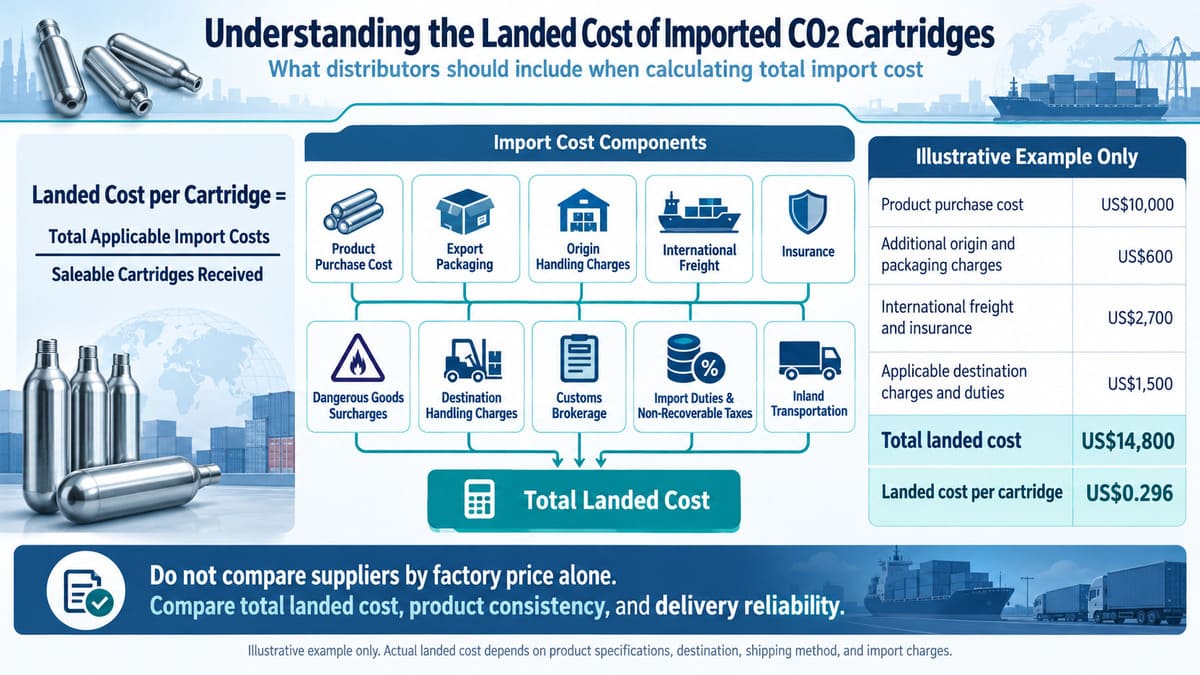
Price is a major consideration for wholesale distributors.
However, the lowest factory unit price does not necessarily result in the lowest final import cost.
Distributors should compare suppliers based on total landed cost, product consistency, and delivery reliability.
The unit price may vary depending on:
Cartridge filling weight and size.
Cylinder material and construction.
Thread and connection specifications.
Order quantity.
Packaging requirements.
Customization requirements.
Required testing and documentation.
Production scheduling.
Agreed delivery terms.
Products with different configurations should not be compared solely by price per cartridge.
For example, a standard unthreaded 12g cartridge and a threaded 33g cartridge for a specialized inflation system have different technical requirements.
International buyers should understand the Incoterms used in supplier quotations.
| Incoterm | General meaning | Main buyer consideration |
|---|---|---|
| FCA | Seller delivers to the carrier or another nominated party at the agreed place | Buyer arranges the main transport under the agreed allocation of responsibilities |
| FOB | Seller delivers goods on board the vessel at the named port | Buyer arranges main carriage; intended for sea or inland waterway transport |
| CIF | Seller arranges specified freight and insurance to the destination port | Buyer must understand risk transfer and destination charges |
| DAP | Seller delivers to the agreed destination, ready for unloading | Import clearance and duties generally remain the buyer's responsibility |
| DDP | Seller delivers under terms requiring import clearance and applicable duties | Confirm that the seller can legally perform the import obligations |
The correct Incoterm depends on the actual transportation arrangement and commercial agreement.
FOB and CIF are intended for sea and inland waterway transport.
For some containerized or multimodal shipments, FCA may be more appropriate depending on the point of handover.
DDP should be used carefully because foreign sellers may face legal or practical restrictions when completing import clearance in certain countries.
Always identify the named place and specify the agreed Incoterms edition in the contract.
A practical formula is:
Landed Cost per Cartridge = Total Applicable Import Costs ÷ Saleable Cartridges Received
Total costs may include:
Product purchase cost.
Export packaging.
Origin handling charges.
International freight.
Insurance.
Dangerous goods surcharges.
Destination handling charges.
Customs brokerage.
Import duties and non-recoverable taxes.
Inland transportation.
Other necessary import costs.
Avoid counting charges twice if they are already included in the supplier's quoted price.
The following example is hypothetical and is intended only to demonstrate the calculation.
| Cost item | Illustrative amount |
|---|---|
| Product purchase cost | US$10,000 |
| Additional origin and packaging charges | US$600 |
| International freight and insurance | US$2,700 |
| Applicable destination charges and duties | US$1,500 |
| Total landed cost | US$14,800 |
| Landed cost per cartridge | US$0.296 |
These figures are not current Fairdale prices, freight quotations, or actual duty rates.
Real landed costs depend on the shipment's product specifications, destination, commercial terms, and logistics arrangements.
For accurate procurement planning, distributors should obtain both a current supplier quotation and a detailed freight estimate.
Minimum order quantity and production lead time are important factors when importing CO2 cartridges in bulk.
Both can vary by cartridge model, customization requirements, production capacity, and packaging specifications.
There is no universal MOQ that applies to all Chinese CO2 cartridge manufacturers.
For reference, Fairdale's published standard 12g CO2 cartridge product page lists a minimum order quantity of 50,000 pieces.
However, this should not be assumed to apply to every Fairdale cartridge size, OEM project, or trial-order arrangement.
Distributors should ask whether the quoted MOQ applies to:
Each individual cartridge specification.
Each thread configuration.
Each packaging design.
Each private-label version.
The total purchase order.
Standard versus customized production.
Buyers interested in multiple cartridge sizes should confirm whether mixed-product orders are available and how MOQ is calculated.
Production lead time depends on the confirmed order and factory schedule.
Factors may include raw material availability, cartridge specifications, production quantity, testing requirements, packaging artwork, and customer approvals.
Customized projects may require additional time for sampling and technical review.
A practical purchasing schedule includes:
Specification confirmation → Sample approval → Purchase order → Production → Inspection → Shipping booking → International transportation → Customs clearance → Final delivery
The manufacturing lead time and international shipping transit time should be calculated separately.
For recurring distribution orders, importers should establish inventory reorder points based on expected demand and the verified total replenishment time.
Before making payment, confirm:
Approved product specifications.
Quantity and unit price.
MOQ and packaging conditions.
Production lead time.
Payment terms.
Inspection and acceptance criteria.
Required documentation.
Incoterm and delivery location.
Responsibility for arranging transportation.
Claims and nonconforming-product procedures.
Keeping these conditions documented can help prevent misunderstandings during repeat orders.
Many distributors import CO2 cartridges to sell under their own brands.
Private-label products can help companies develop a consistent retail range, strengthen brand recognition, and support repeat purchasing.
However, CO2 cartridge customization should always be evaluated against product compatibility, technical feasibility, and applicable regulations.
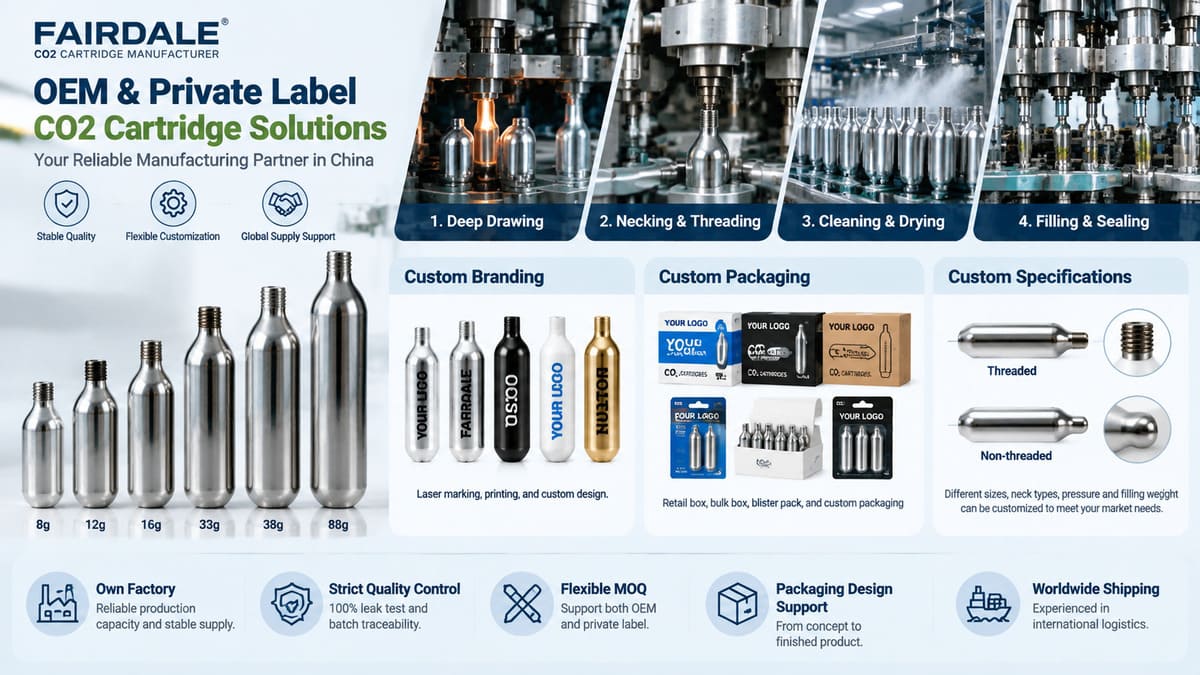
Depending on the project, a manufacturer may evaluate requirements involving:
Brand logos and product identification.
Retail and wholesale packaging.
Printed labels and instructions.
Barcode and SKU information.
Cartridge surface finish.
Product dimensions or connection specifications.
Customer-specific application requirements.
Not every modification is suitable for every cartridge.
Changes to dimensions, materials, threads, or other technical features may require additional engineering verification and conformity assessment.
Fairdale's product catalog identifies a broad range of CO2 cartridge sizes and states that customization services are accepted.
Its product range covers several application categories, including sporting goods, tire inflation, beverage systems, marine safety equipment, and compatible protective airbag equipment.
Distributors considering branded products can discuss their requirements through Fairdale's OEM and ODM services.
Project feasibility, packaging options, technical modifications, and commercial conditions should be confirmed before placing an order.
To receive a relevant quotation, buyers should prepare:
Required CO2 cartridge size.
Intended application.
Equipment or existing cartridge specifications.
Thread type and dimensional requirements.
Target market or destination country.
Expected order quantity.
Packaging and branding requirements.
Applicable certification or documentation requirements.
Preferred delivery terms.
Providing accurate project information can help the manufacturer assess product compatibility, customization feasibility, and commercial requirements more efficiently.
Importing pressurized gas cartridges involves several potential risks.
Avoiding common purchasing mistakes can reduce shipment problems, product incompatibility, and unexpected costs.
| Common mistake | Potential consequence | How to avoid it |
|---|---|---|
| Selecting cartridges by CO2 capacity alone | Incorrect cartridge for the equipment | Verify threads, dimensions, and intended use |
| Assuming all 16g cartridges have the same connection | Incompatible inflators or accessories | Confirm threaded or unthreaded configuration |
| Assuming all 33g cartridges are interchangeable | Incorrect connection or application | Verify the exact 33g product model |
| Choosing suppliers only by factory price | Quality or delivery problems | Evaluate capabilities and total landed cost |
| Assuming every CO2 cartridge has the same UN classification | Shipping or regulatory problems | Confirm shipment-specific classification |
| Treating SDS as complete compliance documentation | Missing required documents | Verify all applicable certificates and declarations |
| Booking transportation after production | Freight rejection or storage charges | Confirm shipping feasibility in advance |
| Skipping sample approval | Returns or unsuitable inventory | Test representative samples |
| Ignoring import duties and surcharges | Underestimated landed costs | Obtain a detailed cost calculation |
| Approving customized packaging without review | Labeling errors or production delays | Confirm artwork and regulatory requirements |
For distributors developing a long-term supply chain, supplier qualification and technical verification should be treated as ongoing purchasing procedures rather than one-time tasks.
Before placing a wholesale CO2 cartridge order, use this checklist to confirm the key purchasing, shipping, and customs requirements.
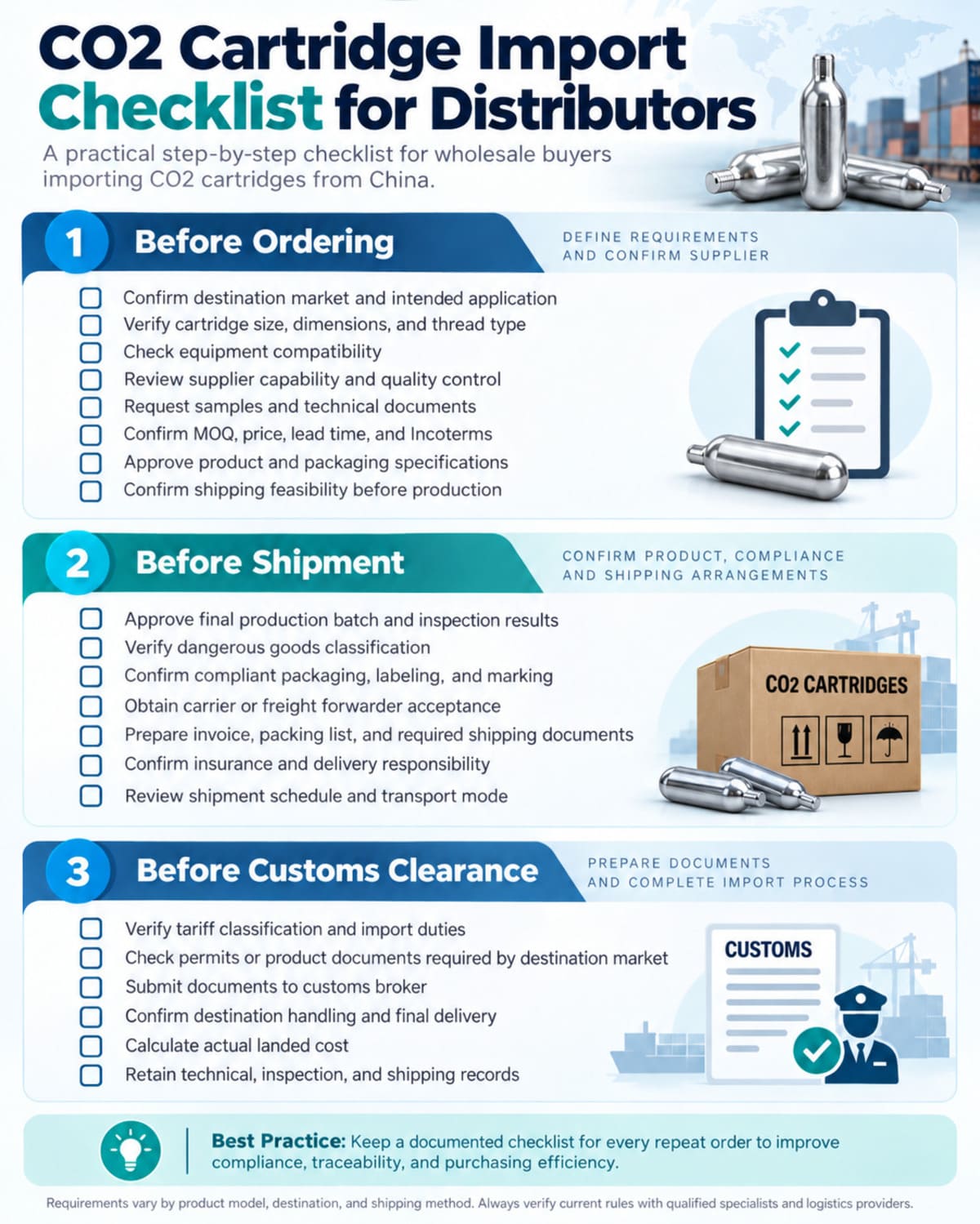
Identify the destination market and intended application.
Confirm the required CO2 filling weight.
Verify cartridge dimensions and thread specifications.
Check compatibility with the intended equipment.
Review the manufacturer's product information and quality controls.
Obtain relevant product samples.
Identify applicable import and conformity requirements.
Confirm the MOQ, price, and lead time.
Agree on packaging specifications and commercial terms.
Confirm freight feasibility before mass production.
Approve the production specifications and samples.
Review the pre-shipment inspection results.
Verify the applicable dangerous goods classification.
Confirm compliant packaging, labeling, and marking.
Obtain acceptance from the selected carrier or freight forwarder.
Check the commercial invoice and packing list.
Prepare required dangerous goods and other transport documents.
Confirm shipment insurance and delivery responsibilities.
Verify the applicable customs tariff classification.
Review import duties and relevant taxes.
Confirm whether import permits or product documentation are required.
Submit the required documents to the customs broker.
Confirm destination handling and final delivery.
Calculate the actual landed cost.
Retain technical, inspection, and shipment records for future orders.
A documented purchasing checklist makes it easier to compare suppliers, reduce repeated errors, and manage long-term wholesale supply.
CO2 cartridges can be imported into many countries when the applicable legal requirements are satisfied.
However, importers must verify the specific product, intended application, destination-market regulations, dangerous goods transportation requirements, and customs procedures.
A product legally sold in one country may require different documentation or conformity assessment in another market.
CO2 cartridges are commonly subject to dangerous goods transportation rules because they contain pressurized gas.
Certain small non-refillable gas cartridges may be classified under UN2037, depending on their design and the relevant regulations.
The correct classification and any available exceptions must be confirmed for the actual shipment.
The correct customs tariff classification depends on the product characteristics and the importing country's tariff rules.
Buyers should obtain detailed product specifications and consult a qualified customs broker or relevant customs authority.
Do not assume that the UN number used for transportation determines the HS code.
Certain CO2 cartridge shipments may be permitted by air when they satisfy the applicable dangerous goods regulations and carrier acceptance conditions.
However, restrictions vary according to the cartridge configuration, packaging, quantity, airline, and route.
Always confirm air-shipment eligibility with a qualified dangerous goods freight forwarder.
Requirements depend on the product design, classification, intended use, and applicable EU regulations.
Certain transportable pressure equipment is subject to Directive 2010/35/EU and relevant conformity assessment and Pi marking requirements.
Additional product-specific requirements may also apply.
Importers should verify the exact regulatory scope instead of assuming that a generic CE certificate is sufficient.
Both configurations are available in Fairdale's product catalog.
The representative threaded 16g version uses a 3/8-24UNF connection, while an unthreaded version is also listed.
Buyers should confirm which connection their inflator or other equipment requires before ordering.
No.
Fairdale's catalog identifies a 33g cartridge with a 1/2-20UNF thread for compatible inflatable life jackets and a separate 33g version using a 3/8-24UNF thread for compatible Coolifting beauty-gun equipment.
The two versions serve different applications and should not be treated as interchangeable.
Always confirm the approved cartridge specification for the intended equipment.
MOQ varies by manufacturer, cartridge size, configuration, and customization requirements.
For reference, Fairdale's published standard 12g cartridge MOQ is 50,000 pieces.
Different product sizes and OEM projects may have different commercial requirements.
Contact the manufacturer with your intended model and quantity for confirmation.
Yes. Manufacturers offering OEM services may evaluate custom packaging, branding, labeling, and certain product specification requirements.
However, customization options, minimum quantities, and development conditions vary by project.
Buyers should provide the intended application, required cartridge specification, target market, and estimated quantity.
The final cost depends on the cartridge type, order quantity, supplier quotation, international shipping, dangerous goods handling, import duties, and destination charges.
Distributors should compare total landed cost rather than factory unit price alone.
For an accurate estimate, request a current supplier quotation together with a destination-specific freight and customs cost calculation.
Choosing a reliable manufacturing partner is an important part of building a successful CO2 cartridge distribution business.
Changzhou Fairdale Metal Tools Co., Ltd., established in 2010 in Changzhou, China, supplies miniature CO2 cartridges for a range of commercial and specialized applications.
Its product catalog includes standard and application-specific cartridge configurations for compatible airguns, bicycle inflation systems, soda water machines, inflatable life jackets, and protective airbag equipment.
Fairdale also accepts customized sourcing requirements, allowing distributors and OEM brands to discuss product specifications, packaging, branding, and wholesale supply arrangements.
Whether you are planning a new distribution program or expanding an established product range, our team can review your purchasing requirements and provide relevant product information.
To discuss your project, please provide:
Required cartridge size and application.
Thread and dimensional specifications, if known.
Estimated purchase quantity.
Destination country.
Packaging or OEM requirements.
Preferred delivery terms.
Contact Fairdale to Request a Wholesale Quote
Our team can review your product requirements and discuss available specifications, commercial conditions, and sourcing arrangements.
Regulatory disclaimer: This article provides general guidance for distributors and importers. Dangerous goods classification, product conformity, transportation requirements, customs procedures, and import duties depend on the specific product, destination, and transport mode. Buyers should verify current requirements with qualified specialists, relevant authorities, and their logistics providers before arranging a shipment.


